Poodle Nutrition: The Diet Factors That Matter for This Breed
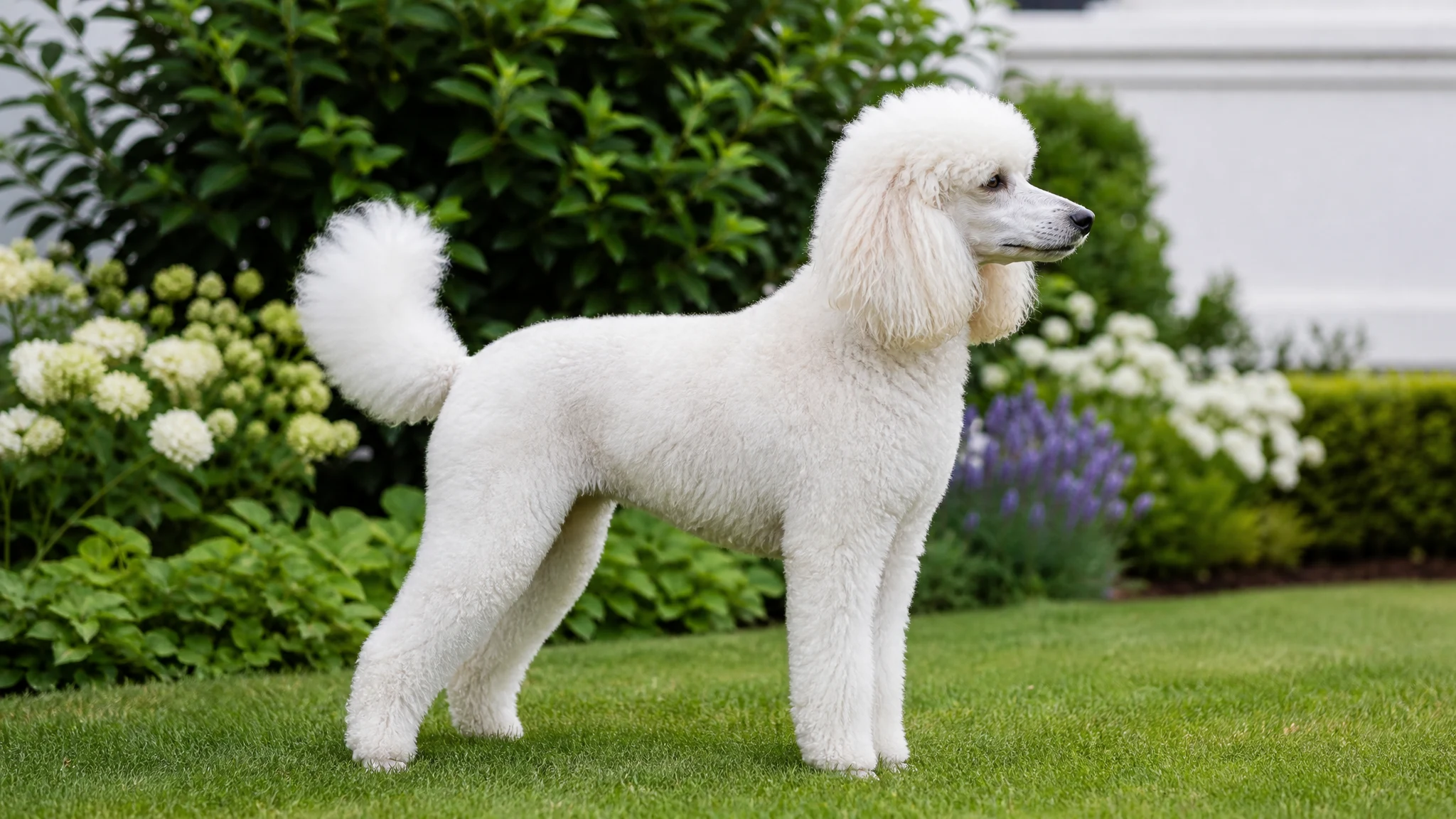
General nutrition information compiled from product labels and published sources, not veterinary advice. Your veterinarian is the right person to choose a diet for your dog, especially one with a health condition.
Good Poodle nutrition starts with one fact that is easy to miss. The Poodle is one breed with three varieties, and they are very different dogs at the dinner bowl. A Toy Poodle and a Standard Poodle do not share a body size, a calorie need or a set of diet-related health concerns.
This guide walks you through how to build a Poodle diet in clear steps. It covers variety, life stage, calorie density, weight, the health topics breed groups raise, and how to read a label. It is a method for thinking, not a single food recommendation.
What You Need Before You Start
- Your Poodle's variety (Toy, Miniature or Standard) and current weight.
- Your dog's life stage: puppy, adult or senior.
- The bag, can or package of the food you feed now, including the nutritional adequacy statement.
- A kitchen scale or a standard measuring cup, so portions are consistent.
- A notebook or phone note for weight checks and treat counts.
- Your veterinarian's contact details. Any question about an individual dog's health goes to them.
A Note on How We Compare Foods
When this site discusses specific foods, we compare label data published by each brand: the adequacy statement, the first ingredients, the guaranteed analysis and the calories. We did not run feeding trials or taste tests. Label data tells you what a manufacturer states. It does not tell you how your dog will do on the food.
For a side-by-side look at specific products, see our label-by-label comparison of dog foods for Poodles.
Step 1: Identify Your Poodle's Variety
The Poodle Club of America describes the varieties by height. A Toy is 10 inches or under at the shoulder. A Miniature is over 10 inches and up to 15 inches. A Standard is over 15 inches.
Weight follows height. One breed guide from Embrace Pet Insurance gives an overall range of about 4 to 70 pounds across all three varieties. That is a wide spread, so a Poodle-wide feeding rule would be meaningless. Write down which variety you have, and read every later step with that in mind.
Many foods are labeled by dog size rather than by breed. In practice, Toy and Miniature Poodles are usually matched to small-breed formulas. The Standard is a larger, deep-chested dog, so its needs differ. That mapping is a reasonable reading of the sizes, not something a breed club states, so ask your veterinarian if you are unsure.
Step 2: Match the Food to Life Stage
Dog foods carry a statement from the Association of American Feed Control Officials (AAFCO). It says whether the food is formulated for growth, adult maintenance or all life stages. This statement is the first thing to find on any package.
- Growth: for puppies. Royal Canin's Poodle Puppy dry food, for example, states it is formulated to meet AAFCO levels for growth.
- Maintenance: for adults. Royal Canin's Poodle Adult dry food carries this kind of statement.
- All life stages: covers both. VICTOR's Hi-Pro Plus Small Breed Adult uses this wording on its product page.
One more phrase matters for Standard Poodle puppies. Whole Dog Journal explains that growth and all-life-stages foods carry either a statement that they cover growth of large-size dogs (70 pounds or more as an adult) or an exception for them. Freshpet's Small Dog Bite Size Chicken Recipe, for example, states it is for all life stages except growth of large-size dogs. A Standard can reach the top of the breed's weight range, so ask your veterinarian whether that exception matters for your puppy.
The age at which a Poodle counts as an adult is not given in the breed sources we relied on. Royal Canin labels its Poodle Adult formula for dogs 10 months and older. Ask your veterinarian when to switch your own dog.
Step 3: Learn What the Label Numbers Mean
The guaranteed analysis lists minimum protein and fat and maximum fiber. For example, Royal Canin's Poodle Adult dry food lists 28% minimum protein, 17% minimum fat and 4% maximum fiber. VICTOR's Hi-Pro Plus Small Breed Adult lists 30%, 14% and 5%.
Be careful comparing across food types. Wet and fresh foods contain a lot of water, so their percentages look low next to dry food. Royal Canin's Poodle Adult canned loaf lists 7.5% protein as fed. That does not make it a lower-protein food in a fair comparison. Hill's lists dry matter averages on several pages, which is a different basis again. Compare like with like, or compare on a dry matter basis.
The ingredient list is ordered by weight before cooking. The first few items show what the recipe is built around. They do not show quality on their own, and a long list is not automatically better than a short one. Be skeptical of any claim that one ingredient is a cure-all.
Step 4: Compare Calorie Density
Calories per cup matter a great deal for small dogs, because a small change in portion is a large change in daily intake. Here is the calorie data published on the brand pages for a handful of foods.
| Food | Form | Stated calories |
|---|---|---|
| Royal Canin Poodle Adult | Dry | 353 kcal ME per cup (calculated) |
| Royal Canin Poodle Puppy | Dry | 385 kcal ME per cup (calculated) |
| Hill's Science Diet Adult Small & Mini Chicken & Brown Rice | Dry | 357 kcal per cup |
| Hill's Science Diet Puppy Small & Mini Chicken & Brown Rice | Dry | 418 kcal per cup |
| VICTOR Hi-Pro Plus Small Breed Adult | Dry | 360 kcal per cup |
| Freshpet Small Dog Bite Size Chicken Recipe | Fresh | 267 kcal per cup (calculated) |
| Nom Nom Chicken Cuisine | Fresh | 244 kcal per cup (calculated) |
A cup of puppy food packs more energy than a cup of adult food. A cup of fresh food, by these numbers, holds fewer calories than a cup of dry. So you cannot swap one food for another cup for cup. Switching foods means recalculating the portion from the new label.
Step 5: Start From the Label's Feeding Guide, Then Adjust
Every feeding guide is a starting point. Royal Canin's pages point to a daily table by weight and activity level. Hill's says to adjust amounts to maintain optimal weight and to ask your veterinarian if unsure. VICTOR's adult page says that after age one you should feed to maintain good body condition, using the chart as a guide.
Some brands give amounts for specific weights. Freshpet's Small Dog Bite Size Chicken Recipe lists 1/2 to 1 cup per day for dogs of 5 to 10 pounds. Treat that as that brand's guide for that food, not as a rule for all Poodles.
Puppies are different. VICTOR's puppy page suggests offering as much as the puppy will eat in 20 minutes, in four feedings spaced through the day. Other brands use their own tables. Follow the brand's guide for the food you chose, and ask your veterinarian how it fits your puppy's growth.
Step 6: Manage Weight With Body Condition, Not Only the Scale
The breed sources we relied on do not give obesity statistics for Poodles, so we will not quote any. The general method still applies. Weigh your dog on a schedule, note it, and check body condition by feel and by sight. You should be able to feel the ribs under a light covering. Your dog should have a visible waist from above.
Count treats and chews as food. In a Toy Poodle, a few extra bites a day can be a large share of the daily calories. If the weight or shape drifts, adjust the portion in small steps and tell your veterinarian, who can rule out other causes.
Step 7: Know the Diet-Related Health Topics, and Their Limits
Several health conditions come up in discussions of Poodle diets. For each, here is what the sources say, and where they stop. No food has been shown by these sources to prevent or treat any of them. Your veterinarian decides what is right for an individual dog.
Bloat (gastric dilatation-volvulus, or GDV)
The Cornell Riney Canine Health Center says GDV is far more common in large, deep-chested dogs, and it lists Standard Poodles among the breeds. Cornell also says a preventive surgery called gastropexy reduces the risk of the stomach twisting but does not prevent bloating. That is a point worth raising with your veterinarian if you have a Standard.
The pages we relied on did not give feeding-management advice for GDV. So we will not offer meal schedules or bowl tips as if they were proven. Ask your veterinarian for current guidance, and ask what the warning signs are so you can act fast.
Sebaceous adenitis
The Poodle Club of America calls sebaceous adenitis, a skin disorder, common in Standard Poodles. The club's page does not link it to diet. That means skin and coat claims on a food bag should not be read as a response to this condition.
Hip dysplasia
The Poodle Club of America lists OFA or PennHip hip evaluation as a recommended test for Standard Poodles. The page does not give how common it is, and it does not tie the condition to a particular food. Diet comes in only through general weight management, which your veterinarian can discuss with you.
Addison's disease
The Poodle Club of America describes Addison's disease (hypoadrenocorticism) in general terms on its health page. Embrace's breed guide lists it as a documented condition in Poodles of all sizes. We found no diet guidance for it. A dog with this diagnosis is managed by a veterinarian, and any prescription diet is something only a veterinarian prescribes.
Dilated cardiomyopathy (DCM) and food type
The FDA has investigated a possible link between certain diets and canine dilated cardiomyopathy. Its most recent update that we found was dated December 23, 2022. The agency said it did not plan further public updates until there is meaningful new scientific information. Check the FDA page for anything newer. If you are weighing a grain-free or other non-traditional diet, talk it over with your veterinarian.
Tips for Making the Plan Work
- Change foods gradually. Mix the new food into the old over several days, and ask your veterinarian if your dog has a sensitive stomach.
- Weigh portions. Cup sizes vary, and a scale is more consistent, especially for a Toy.
- Keep the package. The adequacy statement and the batch details are useful if you ever need to ask the brand or your veterinarian a question.
- Ask the brand about anything missing. Several pages do not state kibble size. If kibble size matters for your small dog, contact the brand.
- Write down changes. Note the date you switched foods and any change in stools, appetite or energy, to share with your veterinarian.
Common Mistakes to Avoid
- Treating all Poodles as one size. A diet suited to a Toy may not suit a Standard, and the reverse.
- Swapping foods cup for cup. Calorie density varies, as the table shows.
- Trusting the front of the bag. Photos and slogans are marketing. The adequacy statement, ingredient list and guaranteed analysis are the information.
- Comparing percentages across food types. Water content distorts wet and fresh numbers.
- Counting treats as free. Small dogs feel the calories fast.
- Expecting a food to fix a health issue. Food is one part of care. A diagnosis belongs with a veterinarian.
- Adding supplements without advice. Ask your veterinarian before adding anything to a complete diet.
What to Expect
A food that fits your dog's life stage and calorie needs may help support a steady weight and consistent energy. Many owners also see steady, well-formed stools once a dog settles onto a new food, though results vary from dog to dog. We cannot promise any outcome, and the sources we relied on do not tie any specific food to better skin, coat or joint health.
Give any new food a few weeks, with regular weight and body condition checks. If your dog loses or gains weight, has ongoing digestive trouble or seems unwell, contact your veterinarian rather than changing foods repeatedly.
Putting It Together
- Note your Poodle's variety and current weight.
- Choose a food whose adequacy statement matches the life stage.
- Read the guaranteed analysis on a like-for-like basis.
- Compare calories per cup before switching.
- Start from the label's feeding guide and adjust by body condition.
- Discuss breed-linked health topics with your veterinarian, especially bloat risk in a Standard.
- Review the plan whenever your dog's life stage, weight or health changes.
When you are ready to look at specific products, the label-by-label comparison sets out the published data for each one.
Sources
- Poodle Club of America, Sizes of Poodles
- Poodle Club of America, Health
- Cornell Riney Canine Health Center, GDV or Bloat
- FDA Center for Veterinary Medicine, Investigation into Potential Link between Certain Diets and Canine Dilated Cardiomyopathy
- Whole Dog Journal, In the Fine Print: Nutritional Adequacy Statements
- Embrace Pet Insurance, Poodle breed guide
- Royal Canin USA, Poodle Adult
- Hill's Pet Nutrition, Adult Small & Mini
- VICTOR, Hi-Pro Plus Small Breed Adult
- Freshpet, Small Dog Bite Size Chicken Recipe
- Nom Nom, Chicken Cuisine