The Best Dog Food for Poodles, Compared Label by Label
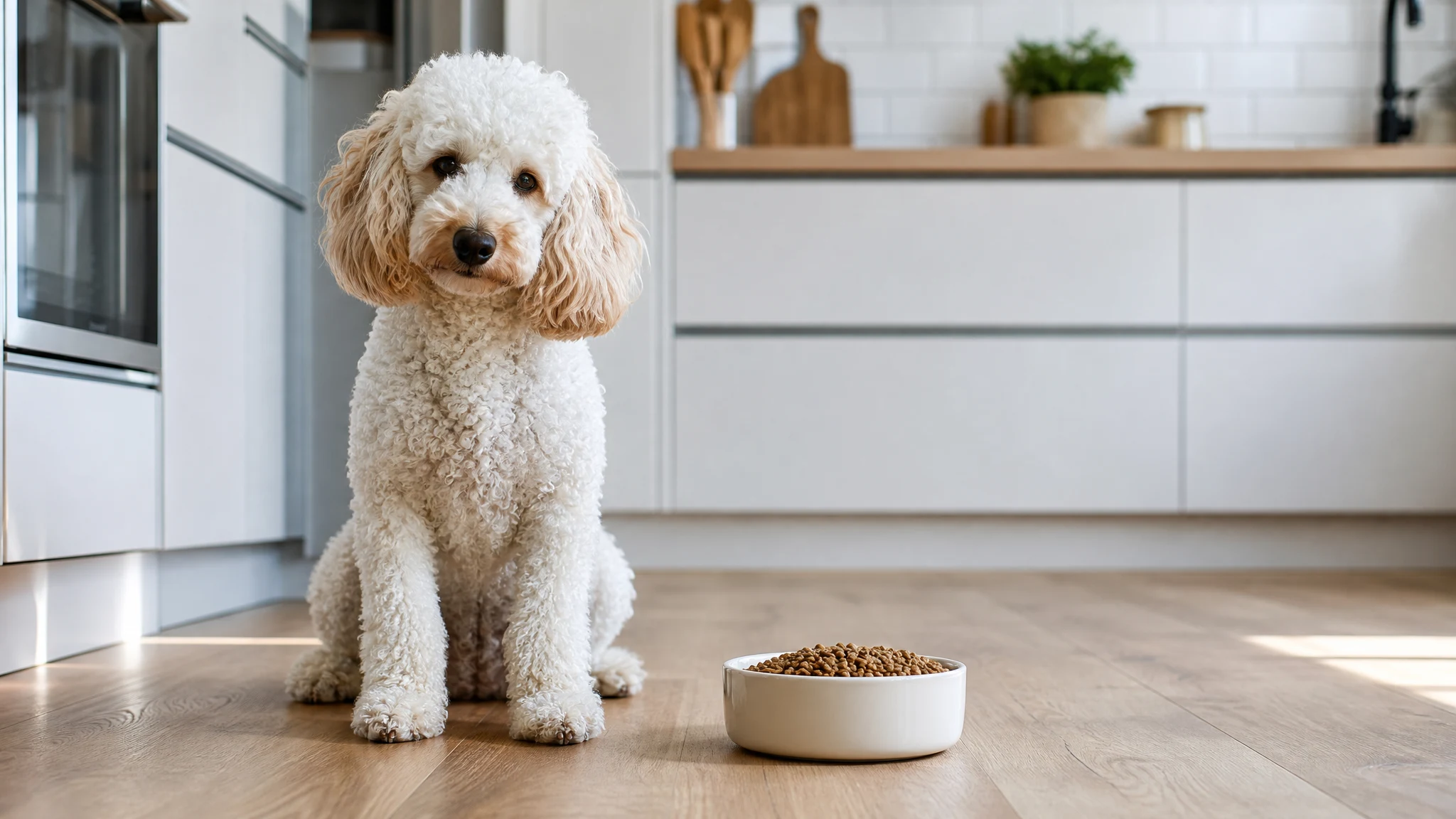
General nutrition information compiled from product labels and published sources, not veterinary advice. Your veterinarian is the right person to choose a diet for your dog, especially one with a health condition.
Most pages about the best dog food for Poodles hand you a ranked list and a confident tone. This one does something plainer. It lays the printed label data side by side and tells you what each label does and does not say.
The goal is to help you read poodle food labels yourself, so you can decide which food fits your dog and your budget. A veterinarian makes the final call for any individual dog.
How we compared these foods
We compared label data. That means the information each brand publishes on its own product page: the AAFCO nutritional adequacy statement, life stage, guaranteed analysis (protein, fat, fiber), calories, the first ingredients and kibble size where it is given.
We did not run feeding trials. We did not do taste tests. We did not feed any of these foods to dogs. Nothing here is a claim about how a dog did on a food, how it smells, or whether a dog will eat it.
A label comparison has limits, and you should know them before you read the tables:
- Brands report numbers in different ways. Royal Canin and VICTOR list minimum protein and fat as fed. Hill's Science Diet pages in our comparison list dry matter averages. Those two kinds of numbers are not directly comparable, so we keep them labeled.
- Some details are simply not published on the pages we compared. Kibble size is one. Where a page does not say, we write that it is unknown and suggest you ask the brand.
- Prices change by store and by week. We do not list prices, because we would only be guessing.
- Ingredient order tells you what weighs the most before cooking. It does not tell you how good a food is.
First, which kind of Poodle do you have?
"Poodle" covers three varieties: Toy, Miniature and Standard. The Poodle Club of America describes the varieties by height: Toy is 10 inches or under, Miniature is over 10 and up to 15 inches, and Standard is over 15 inches.
Weight varies a lot across the breed. One breed guide from Embrace Pet Insurance gives an overall range of about 4 to 70 pounds across all three varieties. It does not split that range by variety, so check your own dog's healthy weight with your veterinarian.
This matters for food. A Toy Poodle and a Standard Poodle are very different dogs when it comes to portion size, kibble size and the way a puppy grows. Many foods sold as "small breed" are aimed at Toy and Miniature Poodles. A Standard Poodle may need something else, and that is a good question for your veterinarian.
According to the same Embrace guide, Poodles live about 10 to 18 years, and Standard Poodles can live 12 years or more. That is a long time to feed one dog, which is a good reason to read labels carefully rather than rely on a bag's front panel.
What to look for on a Poodle food label
The AAFCO statement
This is the most useful line on the bag. It tells you whether the food is meant to be complete and balanced, and for which life stage. Look for wording such as "formulated to meet the nutritional levels established by the AAFCO Dog Food Nutrient Profiles" for maintenance, growth or all life stages.
Some brands instead say that animal feeding tests using AAFCO procedures substantiate the food. Hill's Science Diet uses that wording on its puppy page. These are two different ways of backing up a claim. Both are recognized routes, and neither one tells you which food a particular dog will do best on.
Life stage
Match the statement to your dog: growth for puppies, maintenance for adults, or all life stages. An adult-only food is not meant for a growing puppy.
There is one more detail for puppies. Growth and all-life-stages foods carry either an "including growth of large-size dogs (70 pounds or more as an adult)" statement or an "except for growth of large-size dogs" statement, according to Whole Dog Journal's explanation of nutritional adequacy statements. Foods with the "except" wording are not meant for large-breed puppies. If you are raising a Standard Poodle puppy, ask your veterinarian or the brand which statement suits your dog.
Guaranteed analysis
This lists minimum protein and fat and maximum fiber (and moisture). It is a floor and a ceiling, not an exact recipe. Use it to compare foods of the same type. Do not compare a canned food with a dry food on these numbers, because water changes everything.
Calories per cup
Calories decide how much you feed. Two dry foods can differ by tens of kilocalories per cup, and Toy dogs eat very small amounts, so a small difference per cup adds up over time. Use the number to compare foods and to talk with your veterinarian about portions.
The first ingredients
Read the first five. Look at whether each is a named ingredient (such as chicken or beef) or a general term. Notice how many are grains, and whether the same ingredient appears under several names. Remember that fresh meat contains a lot of water, so a meat first in the list can weigh less in the finished food than it seems.
Kibble size
Small mouths may favor small pieces. None of the dry foods in our comparison published a kibble size in millimeters on the pages we used. VICTOR says only "bite-sized" or "appropriate kibble size." Contact the brand if kibble size matters for your dog.
The label data, side by side
Dry foods
Royal Canin and VICTOR figures are minimum protein and fat and maximum fiber, as printed. Hill's figures are dry matter averages from the product page, so read across rows with care.
| Food | AAFCO statement | Protein / fat / fiber | Calories per cup | First ingredients |
|---|---|---|---|---|
| Royal Canin Poodle Adult (adult, 10 months and older) | Maintenance | 28% min / 17% min / 4% max | 353 kcal ME (as fed, calculated) | Corn, chicken by-product meal, brewers rice, wheat gluten, chicken fat |
| Royal Canin Poodle Puppy | Growth | 31% min / 17% min / 3.7% max | 385 kcal ME (as fed, calculated) | Chicken by-product meal, brewers rice, wheat gluten, chicken fat, corn |
| Hill's Science Diet Adult Small & Mini Chicken & Brown Rice | Adult maintenance, substantiated by AAFCO feeding tests | Dry matter: 25% protein / 15.3% fat / 1.5% fiber | 357 kcal | Chicken, brown rice, whole grain wheat, whole grain corn, brewers rice |
| Hill's Science Diet Puppy Small & Mini Chicken & Brown Rice | Growth, substantiated by AAFCO feeding tests | Dry matter: 28.9% protein / 19.7% fat / fiber not stated | 418 kcal | Chicken, whole grain oats, brown rice, chicken meal, chicken fat |
| Hill's Science Diet Adult Perfect Digestion Small & Mini | Adult maintenance | Dry matter: 28% protein / 15.7% fat / 2.2% fiber | 347 kcal | Chicken, brown rice, cracked pearled barley, brewers rice, corn protein meal |
| VICTOR Hi-Pro Plus Small Breed Adult | All life stages | 30% min / 14% min / 5% max | 360 kcal | Beef, chicken meal, beef meal, brown rice, whole grain millet |
| VICTOR Hi-Pro Plus Small & Medium Breed Puppy | All life stages | 30% min / 18% min / 5% max | 383 kcal | Beef, chicken, beef meal, chicken meal, whole grain sorghum |
A few things stand out. The Royal Canin Poodle formulas are the only foods here made specifically for the breed, and corn or chicken by-product meal appear near the top of the ingredient lists. The Hill's and VICTOR foods are small or mini breed formulas rather than Poodle formulas. VICTOR lists beef first and relies on meat meals and grains such as millet or sorghum.
Two VICTOR foods carry an all life stages statement, even though one is sold as an adult food and one as a puppy food. That is a labeling choice worth understanding before you buy.
Picks by situation
These are not winners. They are the foods whose label data match a given situation, with notes on who each might suit. We list no prices, so there are no "budget" or "premium" picks. Check each brand for current pricing.
Adult Toy and Miniature Poodles
Four dry foods fit this group on paper.
- Royal Canin Poodle Adult. A breed-named formula for dogs 10 months and older, with a maintenance statement, 353 kcal ME per cup and the grain-forward ingredient list shown above. It suits owners who want a food built around the breed name and are comfortable with corn and by-product meal in the ingredients. The brand's feeding table runs by dog weight and activity level.
- Hill's Science Diet Adult Small & Mini Chicken & Brown Rice. Chicken first, 357 kcal per cup, and a statement backed by AAFCO feeding tests. It suits owners who want a named meat first and a feeding-tested claim. The page tells you to adjust amounts to maintain optimal weight and to ask your veterinarian if unsure.
- VICTOR Hi-Pro Plus Small Breed Adult. The highest minimum protein in the group at 30%, with 360 kcal per cup. It suits owners who prefer meat and meat meals at the top of the label. After age one, the brand says to feed to keep good body condition and to use the chart as a guide.
- Hill's Science Diet Adult Perfect Digestion Small & Mini. See the sensitive stomach section below.
Puppies
- Royal Canin Poodle Puppy. A growth statement, 31% minimum protein, 17% minimum fat and 385 kcal ME per cup. The ingredient list begins with chicken by-product meal.
- Hill's Science Diet Puppy Small & Mini. Chicken first, then oats and brown rice. It is the most calorie-dense dry food in this comparison at 418 kcal per cup, with a growth statement backed by feeding tests.
- VICTOR Hi-Pro Plus Small & Medium Breed Puppy. Beef and chicken lead the list, 18% minimum fat and 383 kcal per cup. Its statement is all life stages. The brand suggests feeding as much as the puppy will eat in 20 minutes, in four feedings spaced through the day. Many owners prefer measured portions, so talk it over with your veterinarian.
For a Standard Poodle puppy, the question of large-size growth statements applies, as described above. Ask the brand and your veterinarian. The Freshpet foods below carry an "except growth of large-size dogs" wording, so they are not an obvious fit for a puppy that will be large.
Senior Poodles
We could not confirm a senior-labeled Poodle food from the pages we compared, so we are not naming one. Royal Canin and Hill's both sell products for older dogs, but the label data was not available to us, and we will not guess at it.
If you have an older Poodle, check the brand's own pages for a senior formula and ask your veterinarian what your dog needs. Adult maintenance foods are one option, and your veterinarian can tell you whether another suits your dog better.
Weight control
None of the foods we compared is labeled as a weight management food on the pages we used, so we are not putting one forward for that purpose. What the labels do give you is calories per cup, and that is the number to watch.
In dry food it ranges from 347 kcal per cup (Hill's Perfect Digestion) to 418 kcal per cup (Hill's puppy). Fresh food is lower per cup but not directly comparable, because the pieces and moisture differ. If your dog is carrying extra weight, your veterinarian can set a calorie target. Prescription diets are something only a veterinarian prescribes.
Sensitive stomach
Hill's Science Diet Adult Perfect Digestion Small & Mini Chicken & Brown Rice is the one food here that carries a digestion name. Its label shows chicken, brown rice, cracked pearled barley, brewers rice and corn protein meal as the first five ingredients, 347 kcal per cup, and dry matter averages of 28% protein, 15.7% fat and 2.2% fiber.
A product name is not a promise. The label data does not show that it will settle any dog's stomach. If your dog has ongoing digestive trouble, see your veterinarian first, because the cause matters more than the bag.
Wet food
Wet foods are measured by the can, so compare them against each other and not against dry food.
- Royal Canin Poodle Adult Loaf in Sauce. Maintenance statement, 81 kcal ME per can, minimum 7.5% protein and 4.3% fat, maximum 2% fiber. Water, pork by-products, chicken, pork liver and chicken by-products lead the list. The page includes a recommended daily feeding portion table.
- Hill's Science Diet Adult Small & Mini Chicken & Barley and Beef & Barley Entrees. Maintenance statement. The Chicken & Barley can is 163 kcal and the Beef & Barley can is 165 kcal. Dry matter protein is 26.5% and 23.5%, and dry matter fat is 17% and 16.5%.
The Royal Canin can is far smaller in calories than the Hill's can, so "one can" means very different amounts. Check can sizes and feeding guides before mixing wet and dry.
Fresh food
Fresh foods are sold refrigerated, and the brands publish their own label data.
- Freshpet Small Dog Bite Size Chicken Recipe. All life stages except growth of large-size dogs (70 pounds or more as adults). Chicken, chicken liver, carrots, cranberries and eggs lead. Minimum 16% protein and 12% fat, maximum 1.5% fiber, 267 kcal per cup. The feeding guide gives 1/2 to 1 cup per day for dogs of 5 to 10 pounds, in one meal or split into two. Grain free.
- Freshpet Small Dog Chicken & Turkey Recipe with Cranberries & Spinach (1 lb roll). Adult maintenance, 9.5% minimum protein, 7.5% minimum fat, 317 kcal per pound. The guide gives 1/4 to 3/8 pound per day for dogs of 5 to 10 pounds. Grain free.
- Freshpet Vital Small Breed Chicken & Turkey Recipe with Cranberries & Blueberries (roll). All life stages except growth of large-size dogs. 10% minimum protein, 8.5% minimum fat, 354 kcal per half pound. The page points you to the on-package serving size indicators. Whether it is grain free is not stated on the page we used.
- Nom Nom Chicken Cuisine. All life stages (we saw only an excerpt of the full statement). Chicken, sweet potatoes, squash, spinach and dicalcium phosphate lead. 6.5% minimum protein, 4.5% minimum fat, 3.5% maximum fiber, 244 kcal per cup. It is not breed or size specific.
Fresh food usually costs more than kibble, and it needs refrigerator space. We list no prices, so check each brand for the current cost per day for your dog's size.
Breed diet points worth knowing
Bloat in Standard Poodles
Gastric dilatation-volvulus (GDV, often called bloat) is far more common in large, deep-chested dogs, and the Cornell Riney Canine Health Center lists Standard Poodles among the breeds affected. The Poodle Club of America also lists GDV among the breed's health concerns.
Cornell says a preventive stomach-tacking surgery (gastropexy) reduces the risk of twisting but does not prevent bloating. We did not find reliable feeding advice on those pages, so we are not giving any. Ask your veterinarian how to manage meals for a Standard Poodle, and learn the warning signs.
Skin, hips and other conditions
The Poodle Club of America calls sebaceous adenitis a common skin disorder in Standard Poodles. Its page does not tie the disorder to diet, so we make no skin or coat claims about any food here.
The club also lists OFA or PennHip hip evaluation as a recommended test for Standard Poodles, and does not state how common hip problems are. It describes Addison's disease in general terms without a diet link. No food on this page should be read as preventing or treating any of these conditions.
The DCM question
You may have seen concern about grain-free diets and a heart condition called dilated cardiomyopathy. The FDA's most recent update that we found was dated December 23, 2022. The agency said it did not plan further public updates until there is meaningful new scientific information.
The FDA's page is the right place to look for anything newer. Some of the fresh foods above are grain free, while the dry foods are not. We do not draw conclusions from that, and a veterinarian is the right person to ask if you have questions about your own dog.
Red flags to avoid
- No AAFCO statement, or a statement that does not match your dog. An adult-only food for a puppy, or a food that excludes large-size growth for a Standard puppy, is a poor match.
- Health claims on the front of the bag. A food cannot be said to prevent or cure hip problems, allergies, DCM, bloat or skin disease. Treat any such promise with suspicion.
- Comparing different kinds of numbers. A dry matter percentage and an as-fed percentage are not the same. Match like with like.
- Ignoring calories. A bag that says nothing about calories per cup makes it hard to portion a Toy Poodle properly.
- "Poodle" on the front as the whole argument. A breed name is a marketing choice. Read the statement, the numbers and the ingredients behind it.
- Unclear kibble size for a small dog. If the brand will not say, that is a reason to ask.
- Treating a feeding chart as a rule. It is a starting point. Adjust to your dog's body condition with your veterinarian's help.
Where to buy
Start with the brand's own product page. It lists the current statement, ingredients and feeding guide, and many brands have a way to find stores that carry the food. Check there first, because labels and recipes change, and the bag in your hands is the final word.
Before you commit to a large bag, buy the smallest size. Read the printed label against the page, check the best-by date, and introduce the new food gradually, mixing it with the old food over several days.
Fresh foods are sold through the brand and in refrigerated cases at stores, so check the brand's page for availability. Your veterinarian's office can also tell you what it recommends and where to find it.
Putting it together
The best food for Poodles depends on the variety, the life stage, the dog's body condition and your budget. A food that suits a Toy Poodle adult may not suit a Standard Poodle puppy.
- Identify your dog's variety and life stage.
- Find the AAFCO statement that matches, and check the large-size growth wording for a Standard puppy.
- Compare calories per cup, protein, fat and the first five ingredients.
- Ask the brand about anything the label does not say, such as kibble size.
- Introduce the food gradually and watch your dog's weight and condition.
- Bring questions about health, weight and special needs to your veterinarian.
Good poodle food comes down to a label you can read and a plan you can follow. We did not test any of these foods, and the table is a way to ask better questions, not a ranking.
Sources
- Poodle Club of America, Sizes of Poodles
- Poodle Club of America, Health
- Embrace Pet Insurance, Poodle breed guide
- Cornell Riney Canine Health Center, GDV or Bloat
- Whole Dog Journal, In the Fine Print: Nutritional Adequacy Statements
- FDA Center for Veterinary Medicine, Investigation into Potential Link between Certain Diets and Canine Dilated Cardiomyopathy
- Royal Canin USA, Poodle Adult
- Royal Canin USA, Poodle Puppy
- Royal Canin USA, Poodle Adult Loaf in Sauce
- Hill's Pet Nutrition, Adult Small & Mini Chicken & Brown Rice
- Hill's Pet Nutrition, Puppy Small & Mini Chicken & Brown Rice
- Hill's Pet Nutrition, Adult Perfect Digestion Small & Mini
- Hill's Pet Nutrition, Adult Small & Mini Beef & Barley Entree
- VICTOR, Hi-Pro Plus Small Breed Adult
- VICTOR, Hi-Pro Plus Small & Medium Breed Puppy
- Freshpet, Small Dog Bite Size Chicken Recipe
- Freshpet, Small Dog Chicken & Turkey Recipe with Cranberries & Spinach
- Freshpet Vital, Small Breed Chicken & Turkey Recipe with Cranberries & Blueberries
- Nom Nom, Chicken Cuisine