Wet vs Dry vs Fresh Food for Poodles
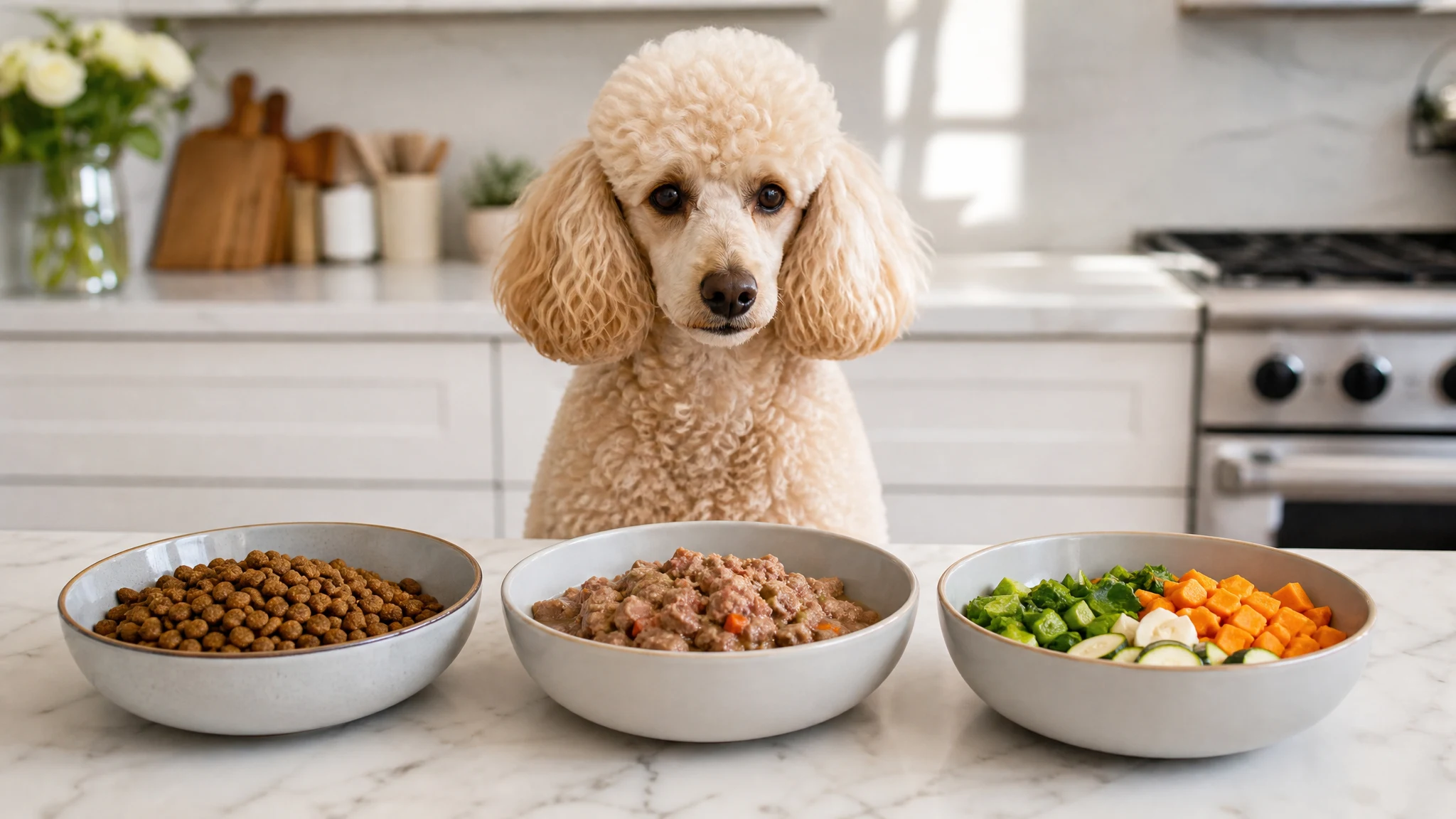
General nutrition information compiled from product labels and published sources, not veterinary advice. Your veterinarian is the right person to choose a diet for your dog, especially one with a health condition.
The wet vs dry dog food question gets louder once fresh food joins in. Each form has real strengths. Each also has marketing wrapped around it.
This guide compares the three forms for Poodles using published label data. We compared labels. We did not run feeding trials or taste tests, so nothing here is a claim about how a dog did on a food.
First, which Poodle are we talking about?
The Poodle Club of America describes three varieties by height. Toy is 10 inches or under, Miniature is over 10 and up to 15 inches, and Standard is over 15 inches.
That spread matters for food. A Toy and a Standard have very different calorie needs and mouth sizes. A kibble, can or roll that suits one may be wrong for another. Treat any Poodle-wide feeding advice with caution.
The labels below are mostly written for small dogs. Standard Poodle owners should read the notes on size and bloat further down.
How the three forms compare
The table uses real products, one or more per form, with figures taken from the brand pages. Where a brand does not publish a number, the table says so.
| Attribute | Dry | Wet (canned) | Fresh |
|---|---|---|---|
| Example products | Royal Canin Poodle Adult; Hill's Science Diet Adult Small & Mini; VICTOR Hi-Pro Plus Small Breed Adult | Royal Canin Poodle Adult Loaf in Sauce; Hill's Science Diet Adult Small & Mini wet entrees | Freshpet Small Dog Bite Size Chicken; Nom Nom Chicken Cuisine |
| Calories | 353, 357 and 360 kcal per cup | 81 kcal per can (Royal Canin); 163 and 165 kcal per can (Hill's) | 267 kcal per cup (Freshpet); 244 kcal per cup (Nom Nom) |
| Protein (minimum) | 28% (Royal Canin); 30% (VICTOR) | 7.5% (Royal Canin) | 16% (Freshpet); 6.5% (Nom Nom) |
| Fat (minimum) | 17% (Royal Canin); 14% (VICTOR) | 4.3% (Royal Canin) | 12% (Freshpet); 4.5% (Nom Nom) |
| First ingredient | Corn, chicken or beef, depending on the product | Water, then pork by-products (Royal Canin); water, then chicken (Hill's) | Chicken |
| Piece size | Not published on the pages we compared | Not applicable | Bite-size pieces (Freshpet); not applicable for rolls |
| Cost per day | Generally the lowest of the three | Generally in the middle, but climbs fast for larger dogs | Generally the highest |
A caution on the numbers. Protein and fat percentages on wet and fresh foods look low because of their water content. They cannot be compared side by side with dry food as printed. Hill's lists dry matter averages on its pages, which is one way to level the field, but not every brand does.
Moisture and calories per serving
Water is the biggest difference between forms. The Royal Canin and Hill's canned foods both list water as the first ingredient. Dry kibble is the opposite: its first ingredients are the solid ones.
This shapes how you read calories. Dry foods in our comparison sit in a narrow band, 353 to 360 kcal per cup. A cup of the Freshpet recipe has 267 kcal, and a cup of Nom Nom Chicken Cuisine has 244 kcal. So the same cup of food gives noticeably fewer calories in the fresh options.
Wet food is trickier because the brands measure by the can, not the cup. Royal Canin lists 81 kcal per can. Hill's lists 163 kcal for the Chicken & Barley can and 165 kcal for the Beef & Barley can. The can sizes are not stated on the pages we used, so do not assume two cans are interchangeable.
The practical point: never swap forms by volume. A cup of dry is not a cup of fresh. Work from the calories on the label and the brand's feeding guide, which is a starting point, not a prescription. Your veterinarian can help set a daily target for your dog and adjust it as the dog's weight changes.
Dry food: pros and cons
Pros
- Calories are easy to measure. Royal Canin, Hill's and VICTOR all publish per-cup figures.
- There are Poodle-named and small-breed options. Royal Canin makes Poodle Adult and Poodle Puppy formulas, and Hill's and VICTOR have small-breed lines.
- Generally the lowest cost per day, which matters over a long life. Embrace Pet Insurance gives a Poodle lifespan of 10 to 18 years.
- Storage is simple.
Cons
- Kibble size is not published on the pages we compared. For a Toy Poodle, check with the brand.
- Ingredient lists vary a lot. Royal Canin Poodle Adult begins with corn, while VICTOR Hi-Pro Plus begins with beef. Neither is automatically better, but the difference is worth reading.
- Some dogs eat it less eagerly than wet or fresh.
Wet food: pros and cons
Pros
- Higher water content, as the water-first ingredient lists show.
- No kibble size to worry about. This can be useful for a very small mouth, though a veterinarian should decide if there is a dental or chewing concern.
- The brands we compared make adult formulas with an AAFCO statement for maintenance.
Cons
- Calories per can are low for the Royal Canin loaf at 81 kcal, so feeding it alone can take many cans. That adds cost and waste.
- Open cans need refrigeration and have to be used within the brand's stated window. Check the label.
- Not every wet food is complete on its own. Read the AAFCO statement to see whether it covers maintenance or a different life stage.
Wet food for Poodles is often used as a topper or partial meal rather than the whole diet. That is a sensible use, but it needs calorie counting. See the mixing section below.
Fresh food: pros and cons
Pros
- Whole-food ingredient lists. Freshpet Small Dog Bite Size Chicken lists chicken, chicken liver, carrots, cranberries and eggs first.
- Moderate calories per cup, at 267 kcal for Freshpet and 244 kcal for Nom Nom.
- Small-dog recipes exist. Freshpet gives bite-size pieces and a guide of 1/2 to 1 cup per day for dogs of 5 to 10 pounds.
Cons
- Generally the highest cost per day. We are not quoting prices because the brands set them and they change.
- Requires refrigeration, which limits travel and boarding.
- Labels differ. Freshpet's small dog recipe is formulated for all life stages except growth of large-size dogs (70 pounds or more as adults). Nom Nom's statement was only partly available to us, so check its full label.
The Freshpet recipes we looked at are listed as grain-free. Grain-free is a marketing term, not a health claim. The FDA investigated a possible link between certain diets and canine dilated cardiomyopathy, and its latest update we found was dated December 23, 2022. The FDA said it does not plan more public updates without meaningful new scientific information. Check fda.gov for anything newer, and ask your veterinarian if heart health is a concern for your dog.
Dental myths
A common belief is that dry food cleans teeth and wet food rots them. The labels we compared make no dental claims for any of these foods, and we found no source in our research that settles the question for Poodles.
So treat the claim as unproven for this comparison. Small breeds can have dental trouble whatever they eat. If you are worried about your dog's teeth, ask your veterinarian. Do not choose a food form on the strength of a dental claim alone.
Mixing forms
Many owners mix, for example kibble with a spoonful of wet food. Nothing in the brand pages we compared forbids it, and none of them describe a mixing method either.
If you do mix, keep a few things in mind:
- Count the calories from both foods. The topper counts, and 81 to 165 kcal per can adds up quickly for a Toy.
- Reduce the main food to make room for the topper, rather than adding on top.
- Change one thing at a time. If your dog has digestive upset, ask your veterinarian.
- Check that the main food is complete. Toppers and rolls are not always meant to stand alone.
Puppies and Standard Poodles
For puppies, look at the AAFCO statement. Royal Canin Poodle Puppy and Hill's Puppy Small & Mini are formulated for growth. VICTOR Hi-Pro Plus Small & Medium Breed Puppy carries an all life stages statement. The brand pages did not give us a growth timeline, so ask your veterinarian when to switch to adult food.
Standard Poodles need extra thought. According to Whole Dog Journal, growth and all-life-stages foods carry either a statement that they cover growth of large-size dogs (70 pounds or more as adults) or an "except for growth of large-size dogs" statement. Freshpet's small dog recipe carries the exception. A Standard Poodle's adult weight is listed by Embrace Pet Insurance as within an overall breed range of 4 to 70 pounds, with no separate figure per variety. For a Standard puppy, confirm with the brand and your veterinarian before choosing a small-dog food.
Bloat, or gastric dilatation-volvulus, is also a Standard Poodle topic. The Cornell Riney Canine Health Center says it is far more common in large, deep-chested dogs and lists Standard Poodles among the breeds. We did not find feeding advice on the page, and we found nothing that says one food form prevents it. Ask your veterinarian about feeding management.
Best for: use cases
- Tight budget or a long-term plan: dry food, which is generally the lowest cost per day.
- A Toy Poodle with a small appetite: a measured mix of a complete dry food with a little wet, with calories counted. Ask the brand about kibble size.
- A dog that ignores kibble: a wet topper or a fresh recipe, with the veterinarian's input.
- Owners who want whole-food ingredient lists: fresh, if the cost and refrigeration suit your household.
- Travel and boarding: dry food is the simplest.
- Standard Poodle puppies: choose by the AAFCO large-size growth statement and your veterinarian's advice, not by form.
The verdict
No form wins for every Poodle. The label data supports a modest conclusion.
Dry food is the practical default. It is the easiest to measure and generally costs the least, and there are Poodle-named and small-breed options. Wet food works well as a partial meal or topper. Its low calories per can make it awkward as a sole diet for most dogs. Fresh food has appealing ingredient lists and mid-range calories per cup, but it is generally the most expensive and needs refrigeration.
The form matters less than whether the food is complete for your dog's life stage, fed in the right amount, and approved by your veterinarian. Most of the dental, digestion and coat claims around each form are not supported by anything on the labels. Choose on completeness, calories, cost and what your dog will reliably eat.
For a closer look at individual recipes, see our label-by-label comparison of dog foods for Poodles.
Sources
- Poodle Club of America, Sizes of Poodles
- Embrace Pet Insurance, Poodle breed guide
- Cornell Riney Canine Health Center, GDV or Bloat
- FDA CVM, Investigation into Potential Link between Certain Diets and Canine Dilated Cardiomyopathy
- Whole Dog Journal, In the Fine Print: Nutritional Adequacy Statements
- Royal Canin, Poodle Adult
- Royal Canin, Poodle Adult Loaf in Sauce
- Hill's Pet Nutrition, Science Diet Adult Small & Mini
- Hill's Pet Nutrition, Science Diet Adult Small & Mini Beef & Barley Entree
- VICTOR, Hi-Pro Plus Small Breed Adult
- Freshpet, Small Dog Bite Size Chicken Recipe
- Nom Nom, Chicken Cuisine