Royal Canin Poodle Puppy Dry Dog Food: How It Compares
General nutrition information compiled from product labels and published sources, not veterinary advice. Your veterinarian is the right person to choose a diet for your dog, especially one with a health condition.
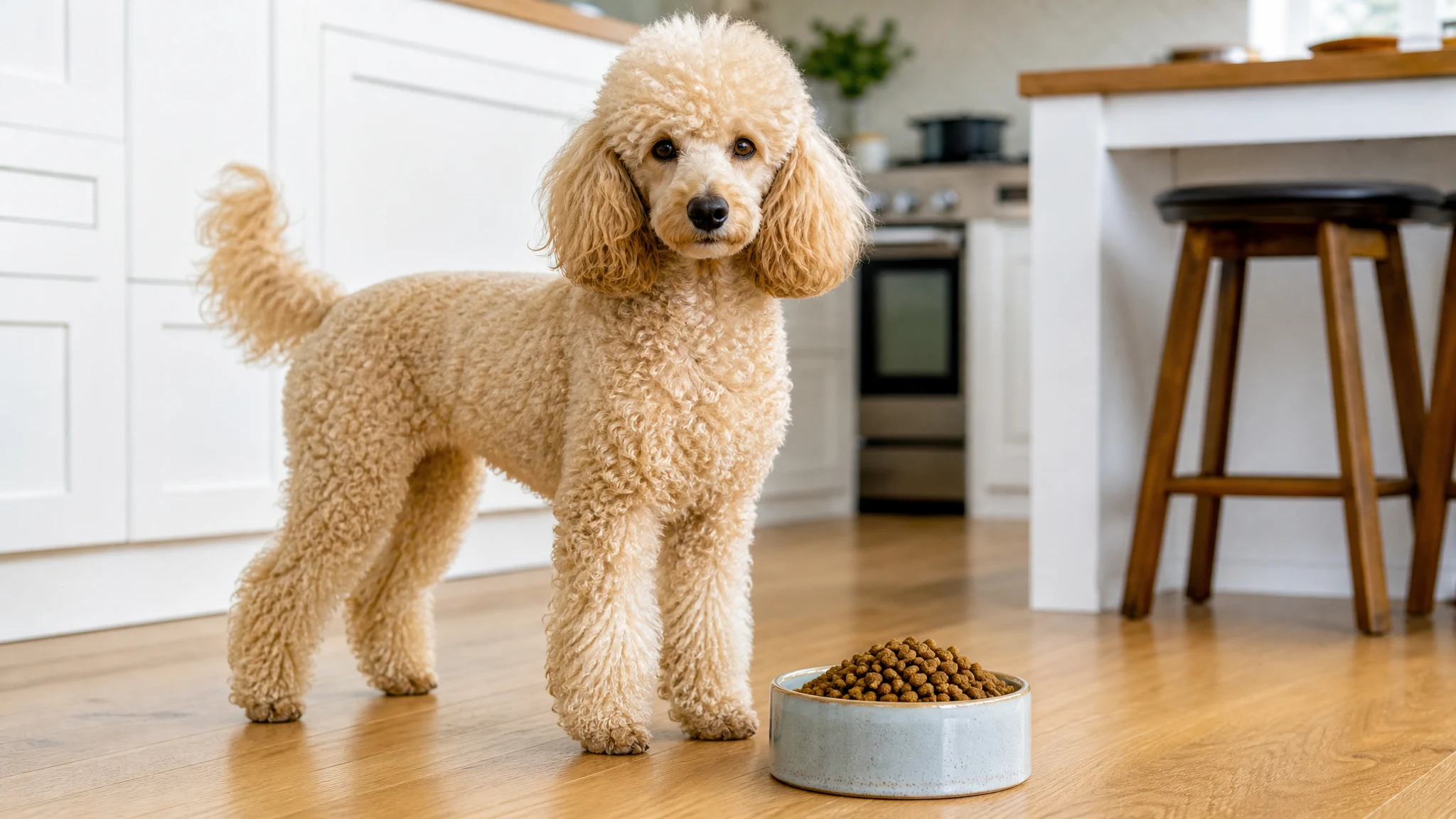
Royal Canin makes a dry puppy food with Poodle on the bag. That naming is a marketing choice, so it is worth checking what the label says before deciding whether it suits your puppy.
This guide looks at royal canin poodle puppy dry dog food next to other puppy-suitable foods. The comparison uses label data only: the AAFCO statement, life stage, protein, fat, calories and first ingredients. We did not run feeding trials or taste tests, and we have not fed any of these foods to a dog.
Know Which Poodle You Are Feeding
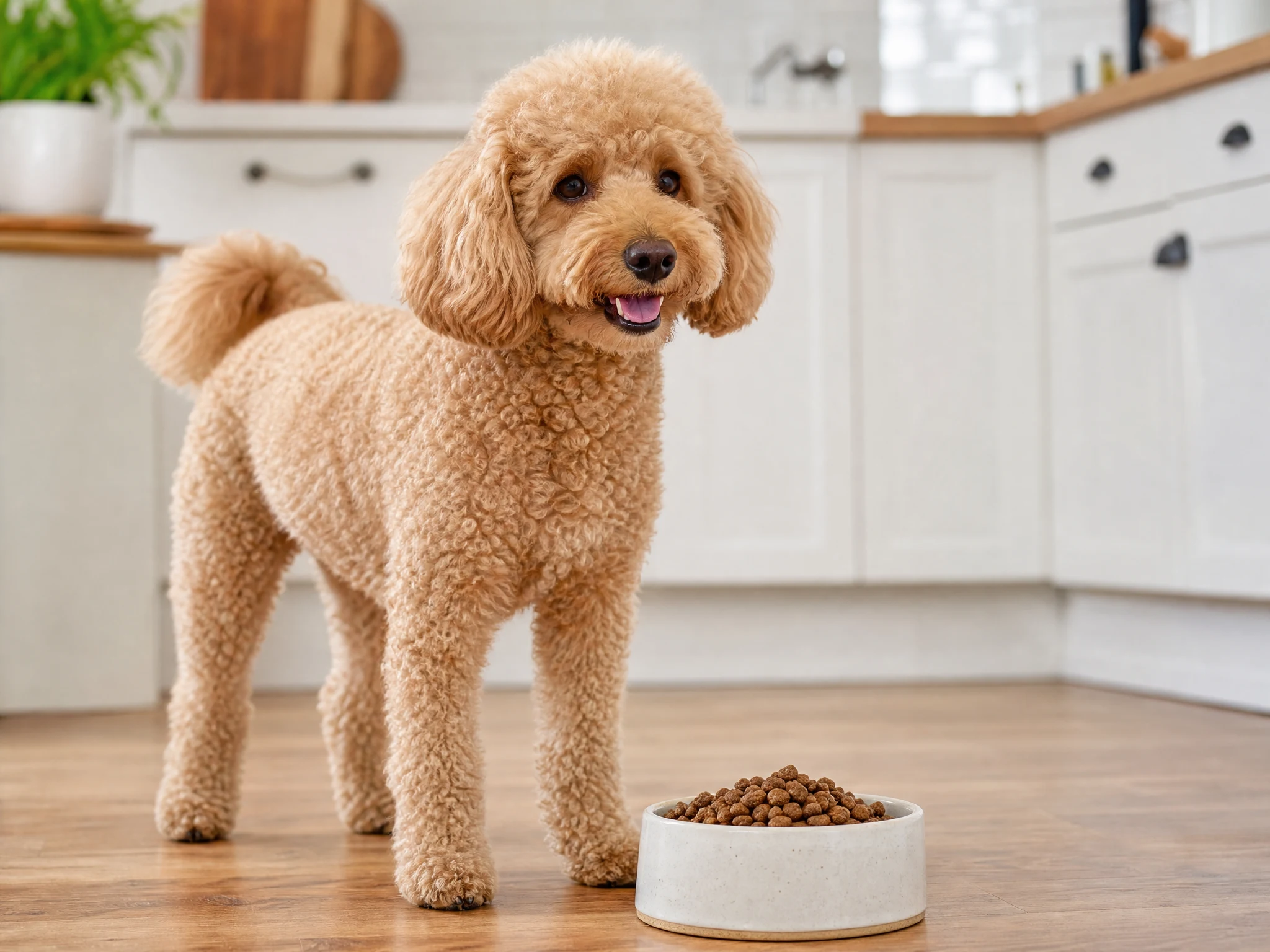
Poodles come in three varieties. The Poodle Club of America describes them by height. Toy is 10 inches or under, Miniature is over 10 and up to 15 inches, and Standard is over 15 inches.
Weight varies a lot as a result. Embrace Pet Insurance gives an overall breed range of 4 to 70 pounds across all three varieties. It does not give a separate range for each one.
This matters for puppy food. A Toy puppy and a Standard puppy do not grow into the same dog. A label that suits one may be a poor fit for the other. Your veterinarian can tell you which formula and portion fit your puppy's expected adult size.
What to Look For on a Puppy Food Label
A growth or all-life-stages statement
The AAFCO statement is the most useful line on the bag. For a puppy, you want wording that says the food meets the AAFCO Dog Food Nutrient Profiles for growth, or for all life stages. A statement that says only "maintenance" is aimed at adult dogs.
Some statements are met by formulation. Others are backed by feeding tests using AAFCO procedures. Both appear on real puppy foods, and the label tells you which one the brand used.
The large-size growth wording
Whole Dog Journal explains that growth and all-life-stages foods carry one of two statements. One says the food is suitable for growth of large-size dogs, meaning 70 pounds or more as an adult. The other says the food is for all life stages except growth of large-size dogs.
This is most relevant if you have a Standard Poodle puppy. Read the full statement on the bag or the brand's page. If you cannot tell whether a food covers large-size growth, ask the brand or your veterinarian.
The first few ingredients
Ingredients are listed by weight before cooking. That is why a meat listed first can look better than it is, since fresh meat contains a lot of water. A "meal" is a dried, concentrated form. Neither is automatically better or worse. The list tells you what the food is built from, not how well it works for your puppy.
Protein, fat and calories together
Guaranteed analysis numbers on dry food are usually minimums for protein and fat and a maximum for fiber. Calories per cup tell you how much energy is in a measured scoop. Two foods with similar protein can differ in calories, which changes how much a puppy needs to eat.
Royal Canin Poodle Puppy: What the Label Data Shows
Royal Canin's own product page for Poodle Puppy lists these details.
- Form: dry
- AAFCO statement: formulated to meet the nutritional levels in the AAFCO Dog Food Nutrient Profiles for growth
- First five ingredients: chicken by-product meal, brewers rice, wheat gluten, chicken fat, corn
- Guaranteed analysis: protein 31.0% minimum, fat 17.0% minimum, fiber 3.7% maximum
- Calories: 385 kcal ME per cup (as fed, calculated)
- Grain-free: no
- Kibble size: not stated in the information we reviewed, so check the brand's page
The page includes a daily feeding table and a prompt to calculate an amount for your pet. Treat any feeding table as a starting point. Your puppy's body condition and your veterinarian's advice should guide the real amount.
One point to read carefully is the growth statement. The wording we reviewed says "growth" and does not state whether it covers large-size dogs. The product is named for the Poodle breed, but the label is what counts. Standard Poodle owners should confirm the full wording with Royal Canin.
Key Features to Compare Side by Side
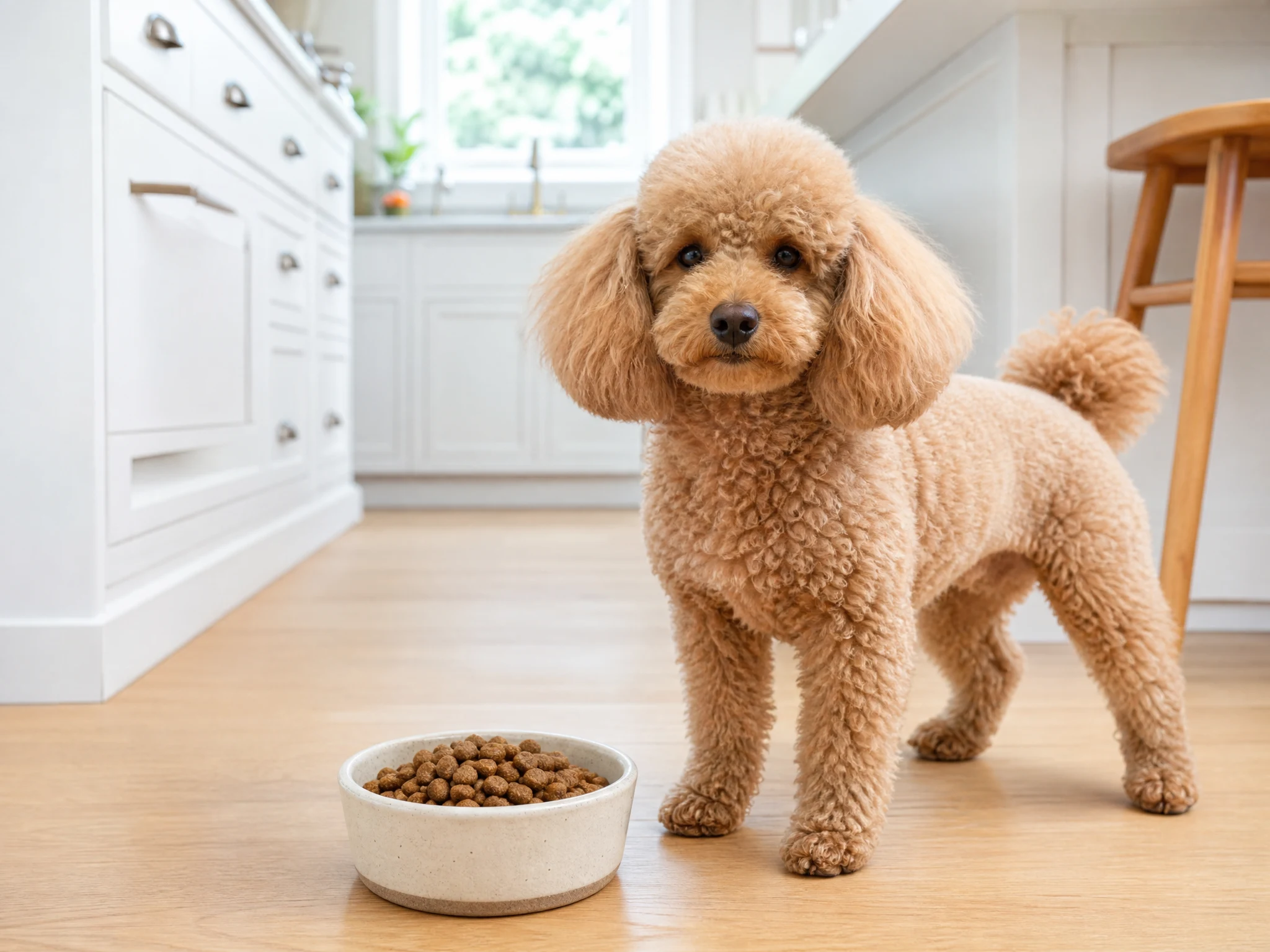
Here is how the Royal Canin formula lines up with two other dry puppy foods that have small-breed labeling. All data comes from each brand's own product page.
| Food | AAFCO statement | First ingredients | Protein / fat | Calories per cup |
|---|---|---|---|---|
| Royal Canin Poodle Puppy | Growth (formulated to meet profiles) | Chicken by-product meal, brewers rice, wheat gluten, chicken fat, corn | 31.0% / 17.0% minimum | 385 kcal |
| Hill's Science Diet Puppy Small & Mini Chicken & Brown Rice | Growth (AAFCO feeding tests) | Chicken, whole grain oats, brown rice, chicken meal, chicken fat | 28.9% / 19.7% (dry matter averages) | 418 kcal |
| VICTOR Hi-Pro Plus Small & Medium Breed Puppy | All life stages | Beef, chicken, beef meal, chicken meal, whole grain sorghum | 30.0% / 18.0% minimum | 383 kcal |
Be careful with the protein and fat column. Royal Canin and VICTOR list minimums as fed. Hill's gives dry matter averages, which remove water from the calculation and use a different method. The numbers cannot be compared directly, so do not rank these foods on that column alone.
What stands out
- Ingredient style: Royal Canin leads with a by-product meal and includes corn and wheat gluten. Hill's and VICTOR lead with named meats. A first-ingredient difference does not tell you which food is better for a given puppy.
- Calories: Royal Canin and VICTOR are close at 385 and 383 kcal per cup. Hill's is higher at 418. A higher-calorie food means a smaller scoop for the same energy.
- Statements: Royal Canin and Hill's use growth statements. VICTOR uses all life stages. Hill's says it used feeding tests, while Royal Canin says it formulated to meet the profile.
- Kibble size: none of these pages gave a measured size we could use. VICTOR says only "appropriate kibble size." If your Toy puppy struggles with large pieces, ask the brand.
Options by Type, Not by Price
We do not list prices. Prices change by store and package size, and we have no reliable figure to quote. Check the brand's own page for current information. Here is how the options group by what they are.
Breed-labeled dry puppy food
Royal Canin Poodle Puppy is the only food in this group, and it is the one this guide centers on. It suits an owner who wants a formula marketed to the breed and who is comfortable with its ingredient style.
Small-breed dry puppy foods
Hill's Science Diet Puppy Small & Mini and VICTOR Hi-Pro Plus Small & Medium Breed Puppy are the other dry options. They are not Poodle-specific, but their labels target smaller dogs. VICTOR's page says to feed a puppy as much as it will eat in 20 minutes, spread over four feedings. Hill's tells owners to adjust amounts to keep an optimal weight and to ask a veterinarian if unsure. These are different approaches, so follow the one on the bag you choose.
Fresh food for small dogs
Freshpet's Small Dog Bite Size Chicken Recipe is a fresh, not dry, option. Its label says it is for all life stages, except growth of large-size dogs. It lists 267 kcal per cup, with chicken, chicken liver, carrots, cranberries and eggs as the first five ingredients. Its guaranteed analysis is 16% protein minimum and 12% fat minimum. Because it is moist, those percentages cannot be compared to dry food. A Standard Poodle puppy who may reach 70 pounds as an adult is outside what that wording covers.
For a deeper side-by-side of many foods, see our label-by-label comparison of dog foods for Poodles.
Red Flags to Watch For
- No AAFCO statement at all. If you cannot find one, the label does not tell you the food is complete and balanced for a puppy.
- A maintenance-only statement on a puppy. Adult foods are not designed for growth.
- Health promises. No food prevents, treats or cures a disease. If a bag or ad claims otherwise, be skeptical. Diet questions for hip, skin, heart or stomach concerns belong with your veterinarian.
- A breed name treated as proof. "Poodle" on a bag is a marketing choice. The AAFCO statement and the label numbers carry the real information.
- Unclear large-size wording. For a Standard puppy, a food excluded from large-size growth is a reason to ask questions.
- Vague kibble or feeding details. If a brand will not say how big the pieces are or how much to feed, ask before buying a large bag.
A Note on Heart Health and Grain-Free Questions
You may see questions about diet and dilated cardiomyopathy (DCM) in dogs. The FDA's page on its investigation gave its latest update on December 23, 2022. The agency said it does not plan further public updates until there is meaningful new scientific information. Check fda.gov for anything newer, and talk with your veterinarian if you have concerns about a specific food.
Where to Buy
The most reliable starting point is the brand itself. Royal Canin, Hill's, VICTOR and Freshpet each publish their own product pages, which show current label details. Those pages are also where you can confirm the full AAFCO wording and ask the company about kibble size or large-size growth suitability.
We do not recommend a specific store, and we do not link to retailers. If you buy elsewhere, check that the package in your hands matches the brand's current label. Look at the AAFCO statement, ingredient list and calories on the bag itself. Your veterinarian's office can also tell you where it recommends buying.
Switching Foods and Portions
None of the sources we reviewed gave a switching schedule, so ask your veterinarian how to move a puppy onto a new food. Use the feeding guide on the label as a starting point, then adjust with your vet based on your puppy's body condition. Puppies vary a lot, and a Toy and a Standard will need very different amounts.
The Bottom Line
On label data, Royal Canin Poodle Puppy has a growth statement, a stated protein and fat minimum, and a mid-range calorie count for the group. Its ingredient list leans on by-product meal, rice, wheat gluten and corn. That is a style difference, not a verdict. The other foods here take different approaches, and a veterinarian can say which one fits an individual puppy.
Sources
- Royal Canin USA, Poodle Puppy product page
- Hill's Pet Nutrition, Science Diet Puppy Small & Mini product page
- VICTOR Super Premium Pet Foods, Hi-Pro Plus Small & Medium Breed Puppy
- Freshpet, Small Dog Bite Size Chicken Recipe
- Poodle Club of America, Sizes of Poodles
- Embrace Pet Insurance, Poodle breed guide
- Whole Dog Journal, In the Fine Print: Nutritional Adequacy Statements
- FDA CVM, Investigation into Potential Link between Certain Diets and Canine Dilated Cardiomyopathy