Best Dog Food for Toy Poodles: A Buying Guide
General nutrition information compiled from product labels and published sources, not veterinary advice. Your veterinarian is the right person to choose a diet for your dog, especially one with a health condition.
Shopping for the best dog food for toy Poodles is mostly an exercise in reading labels. Packaging is full of marketing words. The label panel on the back is where the useful facts are.
This guide shows what to check on a bag, can or fresh roll, then lines up real products by their published label data. We compared labels only. We did not run feeding trials or taste tests, and we are not ranking foods by how a dog liked them.
Start with the dog: what a toy Poodle is
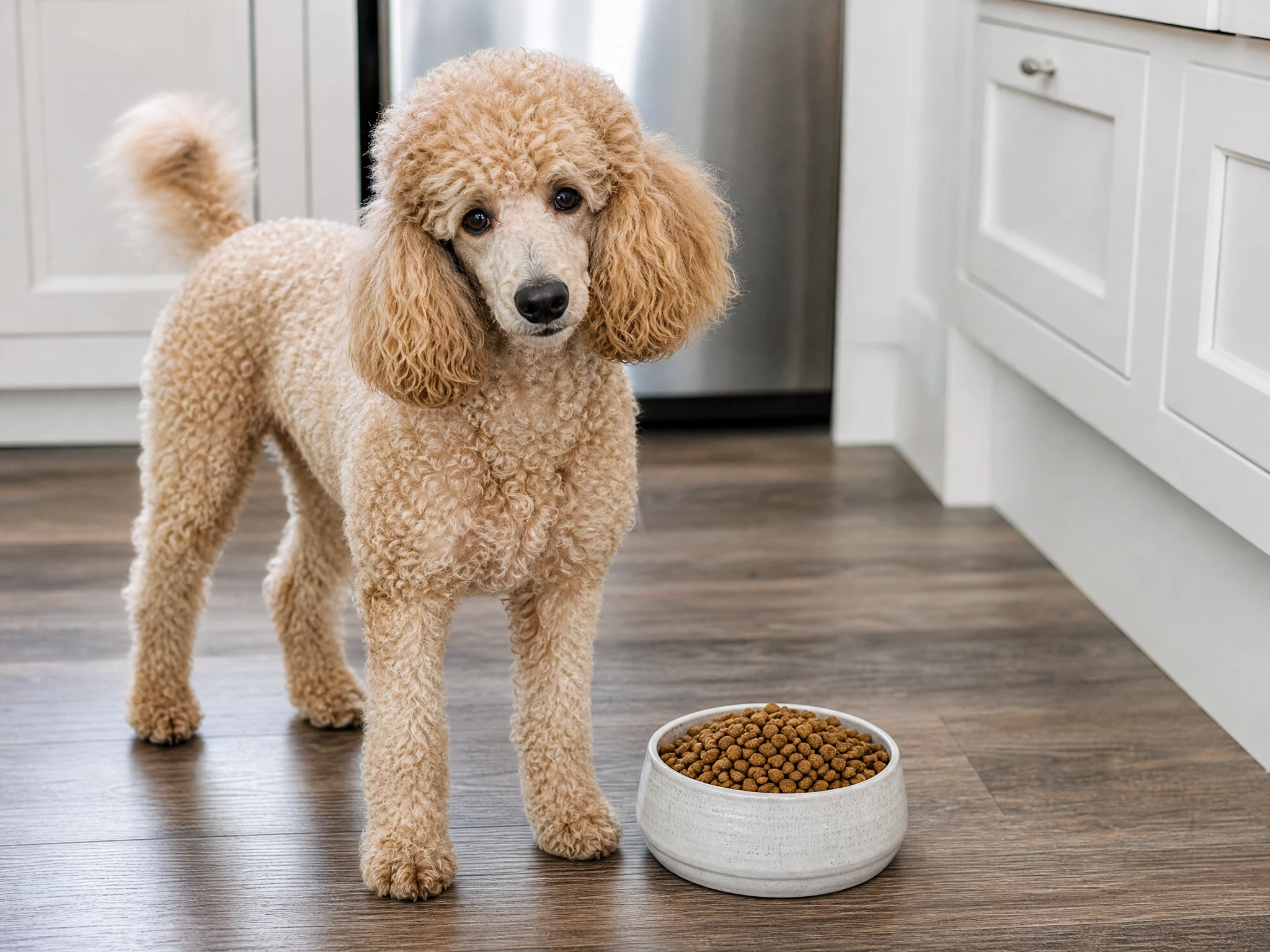
The Poodle Club of America describes three varieties by height: Toy at 10 inches or under, Miniature over 10 and up to 15 inches, and Standard over 15 inches. Diet advice for a Standard does not automatically fit a Toy, so this guide stays with the Toy variety.
Embrace Pet Insurance's breed guide gives a life expectancy of 10 to 18 years across the breed. A Toy may spend many years eating the same kind of food, so it is worth choosing with care and rechecking as your dog ages. For your dog's exact weight target and body condition, ask your veterinarian. We do not state a Toy weight range here because the sources we could verify only give a combined range for all three varieties.
What to look for: quality indicators on the label
1. The AAFCO nutritional adequacy statement
This sentence tells you whether the food is meant to be a complete diet and for which life stage. Look for wording such as "formulated to meet the nutritional levels established by the AAFCO Dog Food Nutrient Profiles" for maintenance, growth or all life stages. Some brands instead say that animal feeding tests using AAFCO procedures substantiate the claim. Both are legitimate routes. Neither tells you how a particular dog will do on the food.
A food with no adequacy statement is a treat or supplement, not a main diet.
2. Life stage match
Puppies, adults and seniors have different needs. A maintenance food is not written for a growing puppy, and a growth or all-life-stages food is a different product from an adult-only one. Pick the statement that matches your dog's age, and ask your veterinarian when a Toy puppy should move to an adult food.
3. The large-breed growth wording
Whole Dog Journal explains that growth and all-life-stages foods carry either an "including growth of large-size dogs (70 pounds or more as an adult)" statement or an "except for growth of large-size dogs" statement. For a Toy puppy the second wording is not a problem. It simply means the food is not designed for giant-breed puppies.
4. The first ingredients
Ingredients are listed by weight before cooking, so the first five tell you the most. Look for named items such as "chicken" or "beef meal" rather than vague terms. Remember that a first ingredient with a lot of water, such as fresh chicken, will weigh less after processing than the list suggests. This is a reason to read ingredients alongside the guaranteed analysis, not instead of it.
5. Guaranteed analysis and calories
Protein and fat minimums, and fiber maximum, are the quick comparison points. Calories per cup matter even more for a small dog, because a few extra kibbles are a big share of a toy Poodle's day. Dry, wet and fresh foods are not comparable on percentages alone because of moisture, so compare like with like.
Key features to compare
- Form: dry, canned or fresh. Each has a different moisture level and storage routine.
- Breed or size formula: some brands make Poodle-specific or small-breed recipes. These are a marketing and design choice, so check the label rather than assuming.
- Kibble size: most brand pages we reviewed do not publish kibble dimensions. If your Toy struggles with larger pieces, check with the brand.
- Calories per cup: use it to compare foods and to adjust portions.
- Feeding guide: treat the chart as a starting point, then adjust to body condition with your veterinarian's input.
Label comparison of products for small and toy dogs
The table below uses the data on each brand's own product page. Where a page publishes only dry matter averages or leaves out a figure, we say so. For a broader side-by-side, see our label-by-label comparison of dog foods for Poodles.
| Product | Form and stage | AAFCO statement | Protein / fat (min) | Calories | First ingredients |
|---|---|---|---|---|---|
| Royal Canin Poodle Adult | Dry, adult (10 months and older) | Maintenance profile | 28% / 17% | 353 kcal per cup | Corn, chicken by-product meal, brewers rice, wheat gluten, chicken fat |
| Royal Canin Poodle Puppy | Dry, puppy | Growth profile | 31% / 17% | 385 kcal per cup | Chicken by-product meal, brewers rice, wheat gluten, chicken fat, corn |
| Hill's Science Diet Adult Small & Mini Chicken & Brown Rice | Dry, adult | Animal feeding tests using AAFCO procedures | Dry matter average 25% / 15.3% | 357 kcal per cup | Chicken, brown rice, whole grain wheat, whole grain corn, brewers rice |
| Hill's Science Diet Puppy Small & Mini | Dry, puppy | Animal feeding tests using AAFCO procedures | Dry matter average 28.9% / 19.7% | 418 kcal per cup | Chicken, whole grain oats, brown rice, chicken meal, chicken fat |
| VICTOR Hi-Pro Plus Small Breed Adult | Dry, all life stages | All life stages profile | 30% / 14% | 360 kcal per cup | Beef, chicken meal, beef meal, brown rice, whole grain millet |
| Freshpet Small Dog Bite Size Chicken | Fresh, all life stages | All life stages, except growth of large-size dogs | 16% / 12% | 267 kcal per cup | Chicken, chicken liver, carrots, cranberries, eggs |
Protein and fat percentages across dry, fresh and canned foods are not directly comparable because water content differs. Hill's pages give dry matter averages rather than guaranteed minimums, so those rows are not directly comparable with the others either.
Top picks by type of buyer
We have no verified prices for any of these foods, and prices change by store and size. So instead of ranking by cost, we group picks by what a label shows. Check each brand's page for current sizes, and compare the cost per day on your own.
If you want a Poodle-specific formula
Royal Canin makes a Poodle Adult dry food, a Poodle Puppy dry food and a Poodle Adult loaf in sauce. All three are formulated to meet AAFCO profiles. The adult dry food lists corn first, which you may or may not prefer. The canned loaf lists water first, then pork by-products and chicken, with 7.5% protein and 4.3% fat minimums and 81 kcal per can. The page does not give kibble size for the dry foods.
If you want a small-breed food with named meats first
Hill's lists chicken first in its Adult Small & Mini and Puppy Small & Mini recipes. Its Perfect Digestion Small & Mini adult recipe is 347 kcal per cup, the lowest of the dry foods in our table. VICTOR's Hi-Pro Plus Small Breed Adult lists beef first and has the highest protein minimum (30%) of the dry options. It carries an all-life-stages statement, and its page says to feed after age one to maintain good body condition.
If you want a fresh food
Freshpet's Small Dog Bite Size Chicken Recipe lists chicken first, comes in bite-size pieces and is 267 kcal per cup. Its feeding guide lists 1/2 to 1 cup per day for dogs of 5 to 10 pounds, which is a starting point only. Freshpet also offers a Small Dog Chicken & Turkey roll. Nom Nom's Chicken Cuisine is not size specific, at 244 kcal per cup, so its portion guide matters even more for a toy dog.
If you are feeding a puppy
Royal Canin Poodle Puppy (385 kcal per cup), Hill's Puppy Small & Mini (418 kcal per cup) and VICTOR's Small & Medium Breed Puppy (383 kcal per cup) are all labeled for growth or all life stages. VICTOR's page suggests feeding as much as the puppy will eat in 20 minutes across four feedings a day. Ask your veterinarian whether that suits a tiny Toy puppy before you copy it.
Red flags to avoid
- Health claims on the front of the bag. No food prevents or treats hip dysplasia, allergies, heart disease or bloat. A veterinarian decides diet for an individual dog, and prescription diets are only something a veterinarian prescribes.
- No AAFCO statement or one that does not match your dog's life stage.
- Missing calorie information. If you cannot find kcal per cup, you cannot compare or portion properly.
- Vague ingredient names where you would expect a named protein.
- "Breed-specific" as proof of quality. A Poodle name on the bag is a design choice. Compare the label like any other.
- Feeding charts treated as rules. Hill's says to adjust amounts to maintain optimal weight and to ask your veterinarian if unsure. That is the right attitude for any brand.
On grain-free foods, the FDA said in its last update, on December 23, 2022, that it did not plan further public updates on its investigation into diets and canine dilated cardiomyopathy until there is meaningful new scientific information. Check the FDA page for anything newer, and talk to your veterinarian before choosing a diet for heart reasons.
A note on Toy Poodles and bloat
Cornell's Riney Canine Health Center lists Standard Poodles among breeds at risk for bloat, which is far more common in large, deep-chested dogs. That concern is about the Standard variety, so do not apply it to a Toy. If you share a household with both, ask your veterinarian about feeding routines for each dog.
Where to buy
Use the brand's own product page to confirm the current formula, ingredients and bag sizes. Then buy from a source you trust, such as the brand directly, a local pet supply store or your veterinary clinic. Whichever you choose, check the printed label on the bag you receive against the page, since recipes can be updated.
Check the best-by date and the condition of the packaging. For fresh foods, confirm the storage instructions the brand gives before you buy.
How to choose and switch
- Pick the life stage that matches your dog.
- Read the AAFCO statement and the first five ingredients.
- Compare calories per cup, then set a starting portion from the brand's guide.
- Watch body condition and adjust with your veterinarian's help.
- Change foods gradually, and tell your veterinarian about any concerns.
The best dog food for toy Poodles is the one that fits your individual dog's life stage, body condition and your veterinarian's advice, and that you can feed consistently. Use the label to narrow the field, not to promise an outcome.
Sources
- Poodle Club of America, Sizes of Poodles
- Embrace Pet Insurance, Poodle breed guide
- Whole Dog Journal, In the Fine Print: Nutritional Adequacy Statements
- FDA CVM, Investigation into Potential Link between Certain Diets and Canine Dilated Cardiomyopathy
- Cornell Riney Canine Health Center, GDV or Bloat
- Royal Canin USA, Poodle Adult
- Hill's Pet Nutrition, Adult Small & Mini
- VICTOR, Hi-Pro Plus Small Breed Adult
- Freshpet, Small Dog Bite Size Chicken Recipe
- Nom Nom, Chicken Cuisine