Best Dog Food for Standard Poodles: A Buying Guide
General nutrition information compiled from product labels and published sources, not veterinary advice. Your veterinarian is the right person to choose a diet for your dog, especially one with a health condition.
Choosing the best dog food for standard poodles starts with reading the label. Marketing language is loud. The label data is not. This guide shows what to check, what to compare and which claims to treat with caution.
One note on method. We compared label data from the brands' own product pages: the AAFCO statement, life stage, protein, fat, calories and first ingredients. We did not run feeding trials or taste tests, so nothing here says how a dog did on a food. For a side-by-side of each product, see the label-by-label Poodle food comparison.
Why the Standard variety needs its own thinking
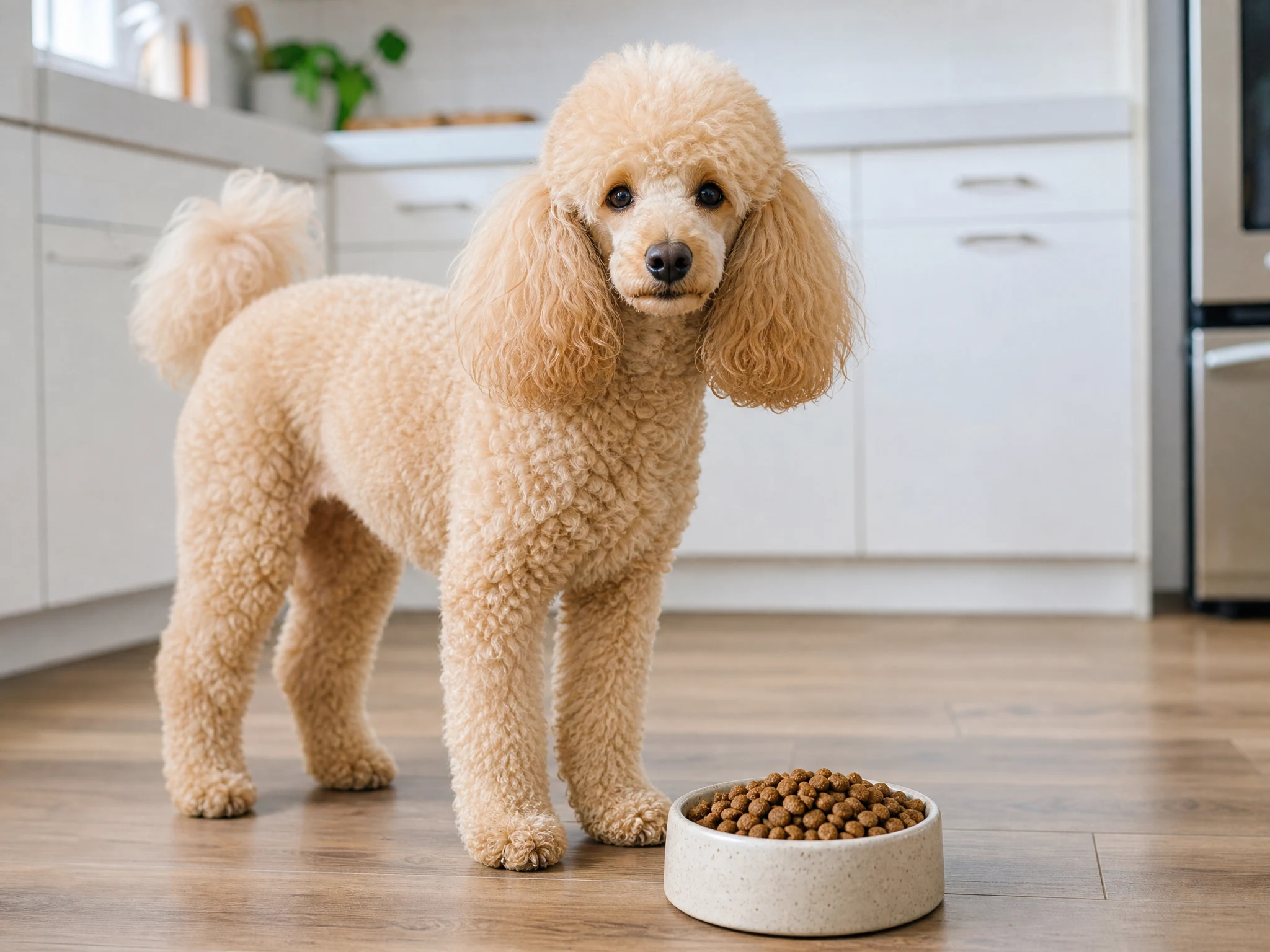
Poodles come in three varieties. The Poodle Club of America (PCA) defines them by height: Toy is 10 inches or under, Miniature is over 10 and up to 15 inches, and Standard is over 15 inches. Embrace Pet Insurance's breed guide gives an overall breed range of 4 to 70 pounds across all three. It does not give a separate range for each variety.
That matters for food. Many products sold for Poodles or for "small and mini" dogs are aimed at the smaller varieties. A Standard Poodle is the largest of the three, so check each label's life stage and size wording before you assume it fits.
Embrace also lists a breed life expectancy of 10 to 18 years, and says Standard Poodles can live 12 years or more. A food you can feed well for many years is worth reading carefully.
What to look for: quality indicators on the label
1. A complete and balanced AAFCO statement
This is the most useful line on the bag. It tells you the life stage the food is formulated for, and whether the claim comes from a nutrient profile or from feeding tests. For example, Royal Canin's Poodle Adult says it is formulated to meet the AAFCO Dog Food Nutrient Profiles for maintenance. Hill's Science Diet Puppy Small & Mini says AAFCO feeding tests substantiate complete and balanced nutrition for growing puppies.
2. The right life stage
Adult maintenance, growth and all life stages are different claims. Match the statement to your dog's age. If you are unsure when your Poodle counts as an adult, ask your veterinarian. We did not find a variety-specific adult age in our sources.
3. The large-size growth wording
According to Whole Dog Journal's explanation of nutritional adequacy statements, growth and all-life-stages foods carry one of two statements. One says the food is suitable for growth of large-size dogs (70 pounds or more as an adult). The other says "except for growth of large-size dogs." Foods with the second wording should not be fed to large-breed puppies. Standard Poodle puppies are not the smallest dogs, so read this line before buying a puppy food, and ask your veterinarian if it is unclear.
4. The first ingredients
Ingredients are listed by weight before cooking. Look at the first five. A named protein such as chicken or beef near the top is easy to understand. Be aware that fresh meat contains a lot of water, so a meat-first list does not tell you how much protein the finished food has. The guaranteed analysis does.
5. Guaranteed analysis and calories
Protein and fat are listed as minimums, fiber as a maximum. Compare foods of the same form only. A canned food at 7.5 percent protein and a dry food at 28 percent are not comparable on those numbers, because the can is mostly water. Calories per cup, or per can, matter just as much for portion planning.
Key features to compare
The table below uses only data from each brand's own product page. "Not stated" means the page did not give a minimum in the form we could use, so check the brand.
| Product | Form | AAFCO life stage claim | Protein / fat | Calories | First ingredients |
|---|---|---|---|---|---|
| Royal Canin Poodle Adult | Dry | Maintenance | 28% min / 17% min | 353 kcal ME per cup | Corn, chicken by-product meal, brewers rice, wheat gluten, chicken fat |
| Royal Canin Poodle Puppy | Dry | Growth | 31% min / 17% min | 385 kcal ME per cup | Chicken by-product meal, brewers rice, wheat gluten, chicken fat, corn |
| Royal Canin Poodle Adult Loaf in Sauce | Canned | Maintenance | 7.5% min / 4.3% min | 81 kcal ME per can | Water, pork by-products, chicken, pork liver, chicken by-products |
| Hill's Science Diet Adult Small & Mini Chicken & Brown Rice | Dry | Maintenance (feeding tests) | Dry matter averages: 25% / 15.3% | 357 kcal per cup | Chicken, brown rice, whole grain wheat, whole grain corn, brewers rice |
| Hill's Science Diet Puppy Small & Mini | Dry | Growth (feeding tests) | Dry matter averages: 28.9% / 19.7% | 418 kcal per cup | Chicken, whole grain oats, brown rice, chicken meal, chicken fat |
| VICTOR Hi-Pro Plus Small Breed Adult | Dry | All life stages | 30% min / 14% min | 360 kcal per cup | Beef, chicken meal, beef meal, brown rice, whole grain millet |
| VICTOR Hi-Pro Plus Small & Medium Breed Puppy | Dry | All life stages | 30% min / 18% min | 383 kcal per cup | Beef, chicken, beef meal, chicken meal, whole grain sorghum |
| Freshpet Small Dog Bite Size Chicken | Fresh | All life stages, except growth of large-size dogs | 16% min / 12% min | 267 kcal per cup | Chicken, chicken liver, carrots, cranberries, eggs |
| Nom Nom Chicken Cuisine | Fresh | All life stages (excerpt only) | 6.5% min / 4.5% min | 244 kcal per cup | Chicken, sweet potatoes, squash, spinach, dicalcium phosphate |
Do not compare the dry and fresh rows directly. Moisture changes every percentage in the table.
Picks by food type
We cannot give prices. Our sources did not list any, and prices change by store and region. So instead of price tiers, these picks are grouped by the type of food. Costs vary by form, bag size and your dog's daily portion, so check the brand's page for current options.
Poodle-named dry foods
Royal Canin makes Poodle Adult and Poodle Puppy dry formulas, plus a canned Poodle loaf. The label data above is what Royal Canin publishes. The pages do not give a kibble size, and they do not say which Poodle variety each formula is built for. Ask the brand whether the formula suits a Standard Poodle. The Royal Canin Poodle Adult page has the feeding table.
One thing to read honestly: corn leads the Poodle Adult ingredient list, and by-product meal leads the puppy list. Neither is automatically bad. They are simply what the label says, and you can decide if that fits your preferences.
Small-breed dry foods with protein-forward lists
VICTOR's Hi-Pro Plus formulas list beef first and give 30 percent minimum protein. Hill's Science Diet lists chicken first on its small and mini recipes. These are sized for small dogs, and the pages do not state kibble size. For a Standard Poodle, ask each brand whether the formula is meant for a dog of that size. The VICTOR small and medium breed puppy page and the Hill's Adult Small & Mini page are the places to check.
Fresh and canned options
Freshpet and Nom Nom sell fresh recipes with short ingredient lists and lower calorie density per cup. The Freshpet small dog recipe carries the "except growth of large-size dogs" wording, so it is not a puppy choice for a large-size dog without your veterinarian's input. Nom Nom's page excerpt did not show a large-size growth statement, so confirm the full statement with the brand. See the Freshpet small dog recipe page and the Nom Nom Chicken Cuisine page.
Using feeding guides and calories
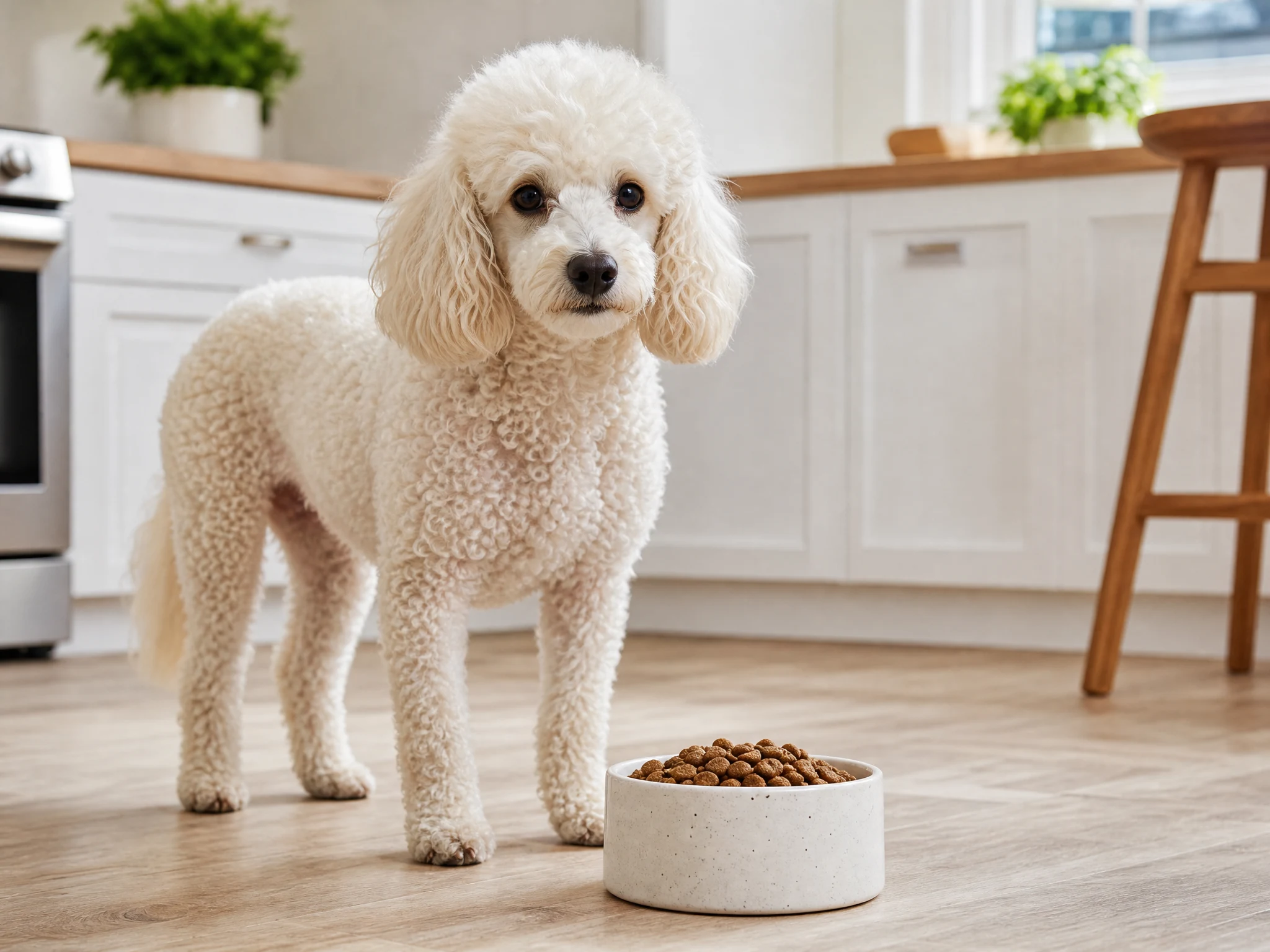
Feeding charts on bags and brand pages are starting points. Hill's says to adjust amounts to maintain optimal weight and to ask your veterinarian if unsure. VICTOR says to feed to maintain good body condition after age one. Freshpet gives 1/2 to 1 cup per day for dogs of 5 to 10 pounds, which is a small-dog range and not a Standard Poodle guide.
Because Standard Poodles are bigger, check the chart row for your dog's actual weight, then adjust by body condition. Calories per cup vary a lot: 244 for the Nom Nom recipe against 418 for Hill's puppy food. The same cup of two foods is not the same meal.
Health topics: what the sources say, and what they don't
Food does not treat or prevent disease, and no label here claims to. A veterinarian decides what is right for an individual dog. Here is what our sources say.
- Bloat (GDV). The Cornell Riney Canine Health Center says GDV is far more common in large, deep-chested dogs and lists Standard Poodles among the breeds. Cornell says preventive gastropexy surgery reduces twisting risk but does not prevent bloating. We did not capture feeding advice from that page, so ask your veterinarian about mealtime routines.
- Skin, hips and Addison's disease. The PCA health page discusses sebaceous adenitis, hip evaluation and Addison's disease. It does not link any of them to a food, so we make no diet claims about them.
- Heart disease and grain-free diets. The FDA's last update on its dilated cardiomyopathy investigation was December 23, 2022. The agency said it did not plan more public updates until there is meaningful new scientific information. Check fda.gov for anything newer, and talk with your veterinarian before choosing a grain-free recipe. Freshpet's small dog recipes are listed as grain free, while the other products above are listed as not grain free.
Red flags to avoid
- No AAFCO statement. If you cannot find one, do not buy the food until you do.
- Wrong life stage. A maintenance food for a growing puppy, or an "except large-size growth" food for a Standard puppy.
- Health claims. A bag that says it prevents or fixes a condition is making a promise a food label should not make.
- Breed name as proof. "Poodle formula" describes marketing. Check the same label items you would check on any food.
- Missing numbers. A brand page that hides calories or the guaranteed analysis makes comparison and portioning guesswork.
- Guarantees. Wording such as "promised results" is not something a feeding chart can honor.
- Size mismatch. A small-breed kibble listed without a kibble size. Ask the brand.
Where to buy
Start with the brand's own page, where the current label, ingredient list and feeding guide are published. Ask your veterinarian which sellers they trust. When you buy anywhere, compare the bag in your hands to the brand page: same recipe name, same AAFCO statement, and a best-by date that suits how fast your dog eats.
Fresh foods have different storage and delivery needs, so read the brand's handling instructions before ordering. We link only to brand pages and do not point you to specific stores.
A simple buying checklist
- Confirm your dog's variety and current weight.
- Find the AAFCO statement and match it to life stage.
- For puppies, read the large-size growth wording.
- Read the first five ingredients and the guaranteed analysis.
- Check calories per cup, then use the feeding chart as a starting point.
- Ask your veterinarian before switching foods or choosing a special diet.
The best dog food for standard poodles is the one whose label fits your dog's age, size and your veterinarian's advice. Compare the data, not the slogan.
Sources
- Poodle Club of America, Sizes of Poodles
- Poodle Club of America, Health
- Embrace Pet Insurance, Poodle breed guide
- Cornell Riney Canine Health Center, GDV or Bloat
- FDA CVM, Investigation into Potential Link between Certain Diets and Canine Dilated Cardiomyopathy
- Whole Dog Journal, In the Fine Print: Nutritional Adequacy Statements
- Royal Canin, Poodle Puppy
- Hill's Pet Nutrition, Puppy Small & Mini
- VICTOR, Hi-Pro Plus Small Breed Adult