Best Dog Food for Poodles by Life Stage
General nutrition information compiled from product labels and published sources, not veterinary advice. Your veterinarian is the right person to choose a diet for your dog, especially one with a health condition.
Choosing the best dog food for Poodles starts with one question: which Poodle do you have? The breed comes in three varieties, and a Toy and a Standard have very different bodies and needs. This guide shows how to read a label, what to compare, and how several real foods look on paper.
A note on method. We compared label data from each brand's own product page: the AAFCO statement, life stage, protein, fat, calories and first ingredients. We did not run feeding trials or taste tests, and we are not saying any food is better for your dog than another. Your veterinarian decides what suits an individual dog.
Start with the variety, then the life stage
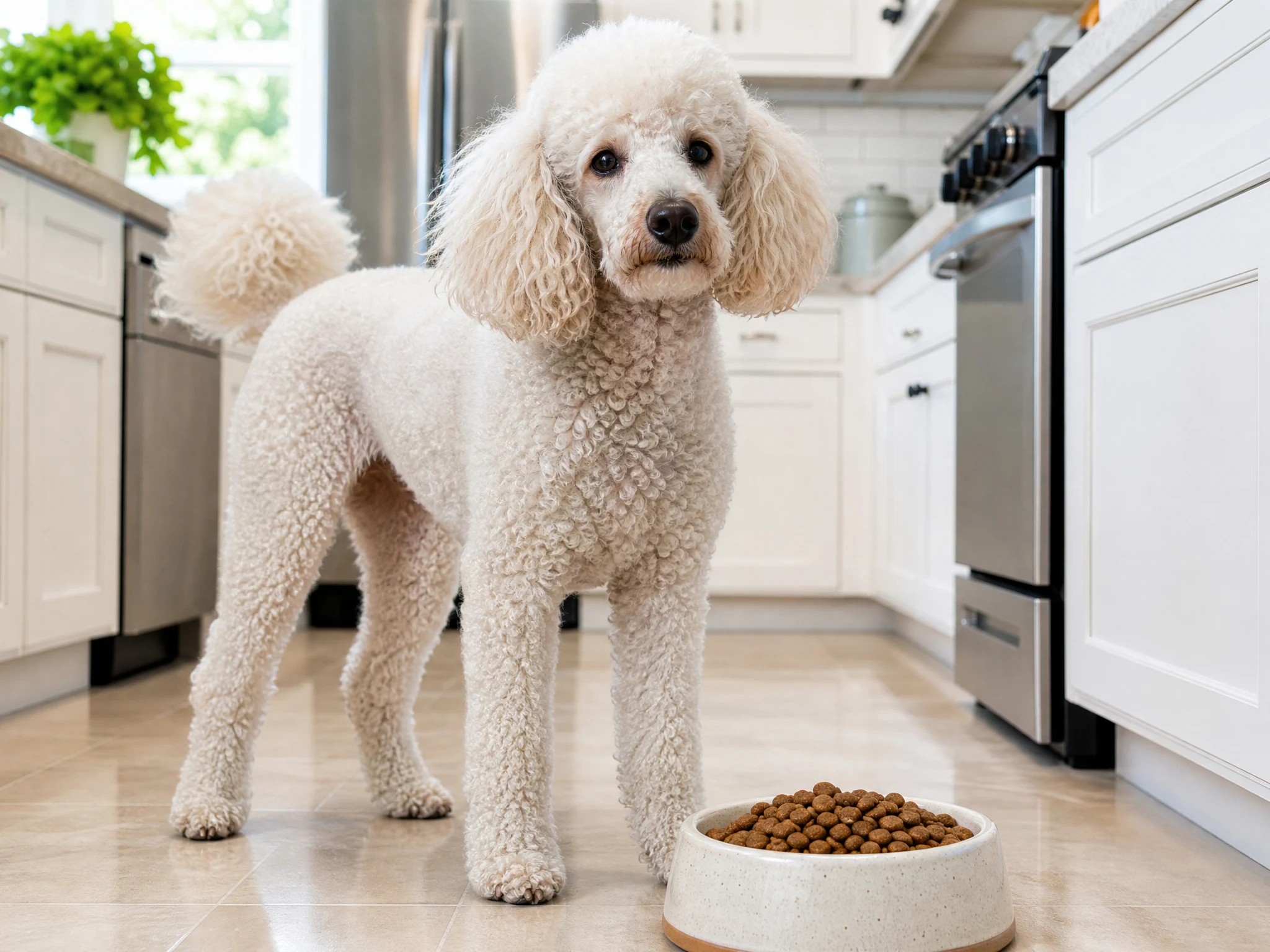
The Poodle Club of America describes the varieties by height. Toy Poodles are 10 inches or under. Miniatures are over 10 and up to 15 inches. Standards are over 15 inches. The club's size page does not give a weight for each variety, so check the brand and your vet for portion questions.
This matters because many foods are labeled by dog size. A small-breed formula is a natural fit for a Toy or Miniature. A Standard is a larger dog, and a small-breed kibble or recipe may not be matched to its size.
Life stage matters just as much. Puppies, adults and older dogs are covered by different nutritional statements on the bag. Embrace Pet Insurance's breed guide puts Poodle life expectancy at 10 to 18 years, so your dog may spend many years in the adult and senior stages. We did not find a source that gives the exact age a Poodle counts as an adult or senior, so ask your veterinarian about timing a switch.
What to look for on a Poodle dog food label
1. An AAFCO nutritional adequacy statement
This is the most useful sentence on the package. It says the food is "formulated to meet" the AAFCO Dog Food Nutrient Profiles, or that animal feeding tests substantiate it, for a named life stage: growth, maintenance, or all life stages. A food with no statement is not a complete diet for daily feeding.
2. A life stage that matches your dog
A puppy needs a growth or all-life-stages food. An adult can eat a maintenance or all-life-stages food. Compare the stage on the label to your dog's current stage, not to the picture on the bag.
3. The large-breed growth line
Growth and all-life-stages foods carry one of two statements, according to Whole Dog Journal's explainer on adequacy statements. One says the food is suitable "including growth of large-size dogs (70 pounds or more as an adult)." The other says "except for growth of large-size dogs." If you are raising a Standard Poodle puppy, read this line and ask your veterinarian which one fits.
4. The first ingredients
Ingredients are listed by weight before cooking. The first five tell you the base of the recipe. Look for a clear, named ingredient such as chicken or beef rather than a vague term. Keep in mind that a long ingredient list does not tell you how the food performs.
5. Guaranteed analysis and calories
Protein and fat percentages are minimums on the label. Fiber is a maximum. Moisture changes the picture: a canned food looks low in protein because it is mostly water. Compare dry foods with dry foods, and use calories per cup to compare portions.
Key features to compare side by side
- Calories per cup: small dogs eat small amounts, so a calorie-dense food goes a long way. Measure carefully.
- Form: dry, wet or fresh. Each has different moisture and calorie density.
- Kibble size: several brand pages we reviewed do not state it. If it matters for a Toy, check with the brand.
- Size targeting: small-breed, breed-specific or none.
- Feeding guide: treat it as a starting point and adjust to body condition, with your vet's guidance.
Puppy foods compared on label data
These are the puppy options we found with brand label data. All figures come from each brand's page.
| Food | AAFCO statement | Protein / fat (min) | Calories | First ingredients |
|---|---|---|---|---|
| Royal Canin Poodle Puppy (dry) | Growth | 31% / 17% | 385 kcal per cup | Chicken by-product meal, brewers rice, wheat gluten, chicken fat, corn |
| Hill's Science Diet Puppy Small & Mini Chicken & Brown Rice (dry) | Growth, by feeding tests | Dry matter averages: 28.9% / 19.7% | 418 kcal per cup | Chicken, whole grain oats, brown rice, chicken meal, chicken fat |
| VICTOR Hi-Pro Plus Small & Medium Breed Puppy (dry) | All life stages | 30% / 18% | 383 kcal per cup | Beef, chicken, beef meal, chicken meal, whole grain sorghum |
Royal Canin's puppy formula is built around the Poodle breed. Hill's and VICTOR target small and medium dogs. The VICTOR page suggests feeding as much as the puppy eats in 20 minutes, in four feedings spread through the day. Treat that as the brand's starting point and talk to your vet about your puppy's growth.
Adult foods compared on label data
| Food | AAFCO statement | Protein / fat (min) | Calories | First ingredients |
|---|---|---|---|---|
| Royal Canin Poodle Adult (dry), adults 10 months and older | Maintenance | 28% / 17% | 353 kcal per cup | Corn, chicken by-product meal, brewers rice, wheat gluten, chicken fat |
| Hill's Science Diet Adult Small & Mini Chicken & Brown Rice (dry) | Maintenance, by feeding tests | Dry matter averages: 25% / 15.3% | 357 kcal per cup | Chicken, brown rice, whole grain wheat, whole grain corn, brewers rice |
| Hill's Science Diet Adult Perfect Digestion Small & Mini (dry) | Maintenance | Dry matter averages: 28% / 15.7% | 347 kcal per cup | Chicken, brown rice, cracked pearled barley, brewers rice, corn protein meal |
| VICTOR Hi-Pro Plus Small Breed Adult (dry) | All life stages | 30% / 14% | 360 kcal per cup | Beef, chicken meal, beef meal, brown rice, whole grain millet |
| Royal Canin Poodle Adult Loaf in Sauce (canned) | Maintenance | 7.5% / 4.3% | 81 kcal per can | Water, pork by-products, chicken, pork liver, chicken by-products |
Do not compare the canned food's protein to the dry foods directly. Water makes up much of the can, so the percentages are not on the same footing. Hill's lists dry matter averages rather than label minimums, so those figures are also not a like-for-like match with the others.
Fresh options
Freshpet's Small Dog Bite Size Chicken Recipe lists an AAFCO statement for all life stages, except growth of large-size dogs (70 pounds or more as adults). Its label shows 16% protein and 12% fat as minimums, 267 kcal per cup, and chicken, chicken liver, carrots, cranberries and eggs as the first five ingredients. Its feeding guide lists 1/2 to 1 cup per day for a 5 to 10 pound dog.
Nom Nom's Chicken Cuisine lists an all-life-stages statement, 244 kcal per cup, and chicken, sweet potatoes, squash, spinach and dicalcium phosphate first. It is not breed or size specific, and the page we reviewed did not show the full statement, so read the whole label on Nom Nom's site. Both fresh brands are far more moisture-rich than kibble, so cup-for-cup comparisons to dry food are misleading.
Seniors and Standard Poodles: where the label stops
We did not find a Poodle-specific senior formula with label data we could verify, so we do not rank one. Many adult maintenance foods and all-life-stages foods are labeled for dogs of any age after growth. If your older Poodle needs a different diet, that is a conversation for your veterinarian, who may recommend a prescription food when it is warranted.
For Standard Poodles, Cornell's Riney Canine Health Center lists the variety among the breeds at risk of gastric dilatation-volvulus, often called bloat. Cornell notes that a preventive gastropexy surgery reduces the risk of twisting but does not prevent bloating. We did not find feeding advice on that page, and no food label can promise to prevent it. Ask your veterinarian about feeding routines for a deep-chested dog.
Top picks by price point
We do not list prices. The brand pages we reviewed did not show prices we could cite, and prices change often. What we can do is group the options by type, which usually tracks cost:
- Everyday dry food: Royal Canin Poodle formulas, Hill's Science Diet Small & Mini formulas and VICTOR Hi-Pro Plus formulas all offer dry options with full label data.
- Wet toppers or wet meals: Royal Canin Poodle Adult Loaf in Sauce and Hill's Science Diet Adult Small & Mini wet entrees are canned options.
- Fresh food: Freshpet and Nom Nom sell refrigerated fresh recipes.
To compare cost fairly, divide the price by the calories in the bag, or by the days the bag lasts at your dog's portion. Get the price from the brand or your seller.
For a deeper look at more products, see our label-by-label comparison of dog foods for Poodles.
Red flags to avoid
- No AAFCO statement, or one that names a different life stage than your dog's.
- Disease claims. A food that says it treats, cures or prevents allergies, hip dysplasia, heart disease or bloat is making a medical claim. The Poodle Club of America lists health concerns for the breed but does not tie them to a specific food.
- Grain-free as a selling point. The FDA has investigated a possible link between certain diets and canine dilated cardiomyopathy. Its latest update we found was December 23, 2022, and it said it did not plan more public updates without meaningful new science. Check fda.gov for anything newer, and discuss it with your vet.
- Guarantees. Any promise of perfect results for every dog is marketing.
- Missing detail. If you cannot find the ingredient list, calories or statement on the brand's page, ask the brand before buying.
- Using a puppy or small-breed food for the wrong dog. Match the label to the variety and age.
Where to buy
Start on the brand's own product page to confirm the current ingredient list, AAFCO statement and feeding guide. Formulas change, and a retailer's listing may lag. Royal Canin, Hill's, VICTOR, Freshpet and Nom Nom each describe their purchase options on their websites. Buy from a seller you trust, check the date on the bag, and keep the original package until the food is gone so you can reread the label.
When you switch foods, ask your veterinarian how quickly to change over, and keep a feeding log for portions and body condition. Use the label guide as a starting point, not a final answer.
Sources
- Poodle Club of America, Sizes of Poodles
- Poodle Club of America, Health
- Embrace Pet Insurance, Poodle breed guide
- Cornell Riney Canine Health Center, GDV or Bloat
- FDA CVM, Investigation into Potential Link between Certain Diets and Canine Dilated Cardiomyopathy
- Whole Dog Journal, In the Fine Print: Nutritional Adequacy Statements
- Royal Canin, Poodle Adult
- Royal Canin, Poodle Puppy
- Royal Canin, Poodle Adult Loaf in Sauce
- Hill's Science Diet, Adult Small & Mini
- Hill's Science Diet, Puppy Small & Mini
- Hill's Science Diet, Adult Perfect Digestion Small & Mini
- VICTOR, Hi-Pro Plus Small Breed Adult
- VICTOR, Hi-Pro Plus Small & Medium Breed Puppy
- Freshpet, Small Dog Bite Size Chicken Recipe
- Nom Nom, Chicken Cuisine