Preparing Your Poodle's Meals: A Feeding Routine Guide
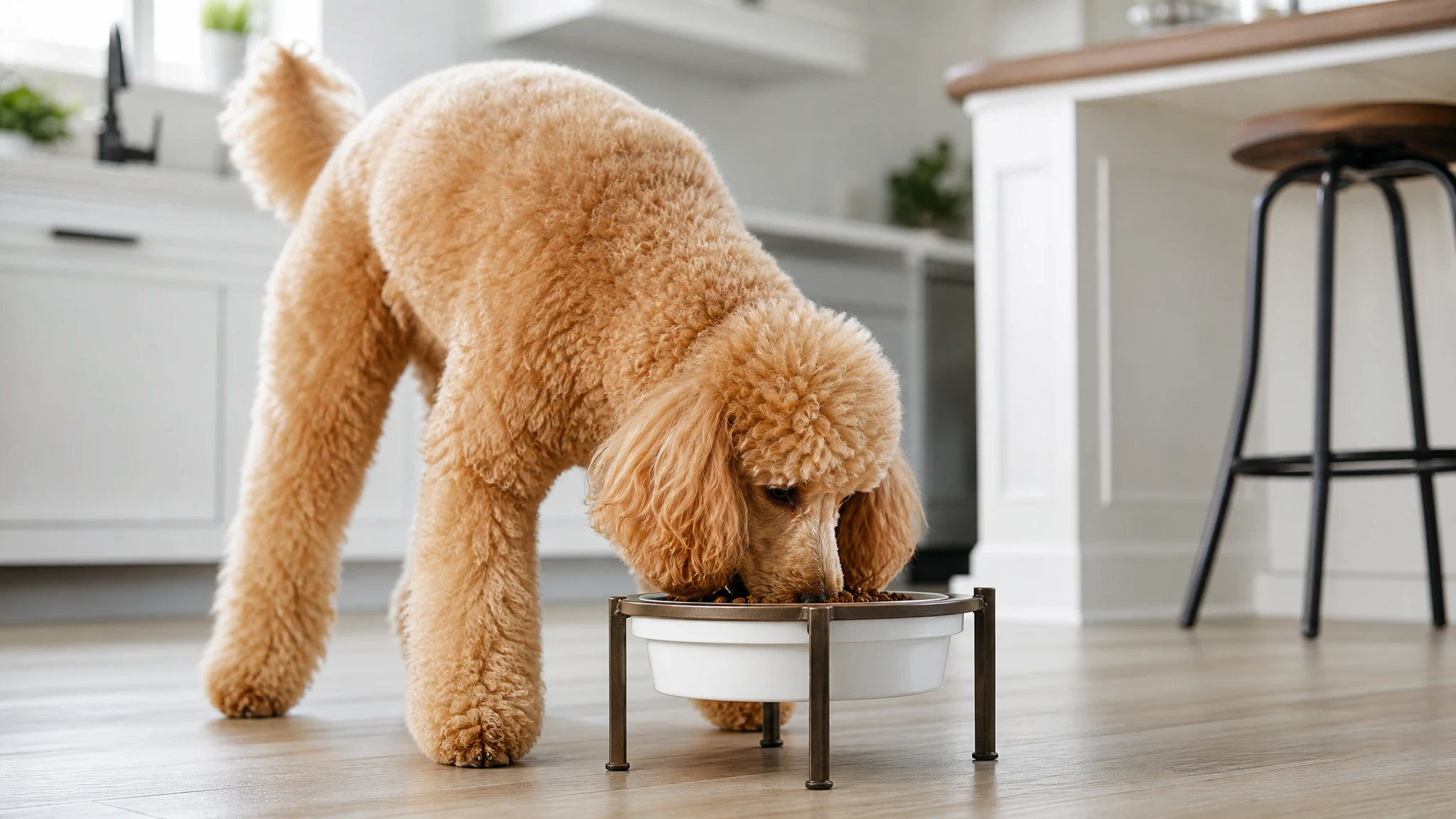
General nutrition information compiled from product labels and published sources, not veterinary advice. Your veterinarian is the right person to choose a diet for your dog, especially one with a health condition.
A steady routine makes mealtime easier for you and your Poodle. Good dog feeding preparation is mostly small habits: reading the label, measuring the same way each time, storing food properly and watching your dog's body condition.
This guide walks through those habits step by step. It compares label information only. We did not run feeding trials or taste tests, and nothing here replaces your veterinarian's advice.
Start with your Poodle's variety
Poodles come in three varieties. The Poodle Club of America describes them by height: Toy at 10 inches or under, Miniature over 10 and up to 15 inches, and Standard over 15 inches. Weight and calorie needs differ a lot between a Toy and a Standard, so a routine that suits one may not suit another.
The Embrace Pet Insurance breed guide gives an overall breed range of about 4 to 70 pounds across all three varieties. It does not give a separate range for each variety, so use your own dog's weight and your vet's guidance, not a breed average.
Materials you will need
- A dry measuring cup or a kitchen scale. A scale is more consistent than a scoop.
- A food bowl sized to your dog, made of stainless steel or ceramic and easy to wash.
- An airtight container for dry food, plus the original bag, which carries the lot number and best-by date.
- A can cover and a lidded container if you feed wet food. Fresh or refrigerated foods need fridge space.
- A notebook or phone note to log weight, portions and treats.
- The feeding guide from your chosen food's label or brand page.
Step-by-step: building the routine
Step 1: Read the label before you pour
Find the nutritional adequacy statement. It says whether the food is formulated to meet the AAFCO Dog Food Nutrient Profiles for maintenance, growth or all life stages. For example, Royal Canin's Poodle Adult dry food states it is formulated for maintenance, and its Poodle Puppy dry food states it is formulated for growth. VICTOR's Hi-Pro Plus Small Breed Adult lists an all life stages statement.
Then check the first few ingredients and the guaranteed analysis. Treat marketing words such as "premium" or "natural" with some skepticism. The statement and the numbers tell you more.
Step 2: Match the food to life stage and size
Puppies need a growth or all life stages food. Adults need a maintenance or all life stages food. Royal Canin lists its Poodle Adult formula for dogs 10 months and older. The sources we reviewed do not give a single age at which every Poodle counts as an adult, so ask your vet when to switch.
Size matters too. Some foods carry the statement "except for growth of large-size dogs (70 pounds or more as an adult)." Freshpet's small dog recipes use this wording. That is a label detail worth noticing if you share your home with a Standard Poodle puppy. Confirm with your vet and the brand before choosing.
Step 3: Find the starting amount on the label
Every feeding guide is a starting point. It is not a prescription. Here are examples of what the brands publish:
- Royal Canin gives a daily feeding table by dog weight and activity level on its Poodle product pages.
- Freshpet's Small Dog Bite Size Chicken Recipe lists 1/2 to 1 cup per day for dogs of 5 to 10 pounds, in one meal or split into two.
- VICTOR says that after age one, you should feed to maintain good body condition, using the feeding chart as a guide. For its small and medium breed puppy food, it says to offer as much as the puppy will eat in 20 minutes, in four feedings spaced through the day.
- Hill's Science Diet says to adjust amounts as needed to maintain optimal weight, and to ask your veterinarian if you are unsure.
For a deeper look at weight and age, see our Poodle feeding chart by age and weight.
Step 4: Adjust for activity and body condition
Two Poodles of the same weight can need different amounts. A dog who runs, swims and trains daily may need more than a calm companion. Start at the label amount, then check your dog every week or two. You should be able to feel the ribs under a thin layer of coverage, and see a waist from above. If that changes, adjust slightly and tell your vet.
Step 5: Pick a schedule and keep it
Most adult dogs do well with two meals a day, and puppies usually need more frequent meals. Freshpet's label allows one meal or two. VICTOR's puppy label describes four feedings. Choose times that fit your day, and keep them steady. Pick up the bowl after about 20 minutes so the meal does not become all-day grazing.
If you have a Standard Poodle, ask your vet about meal timing and size. Cornell's Riney Canine Health Center lists Standard Poodles among the breeds affected by gastric dilatation-volvulus, often called bloat. We did not find feeding-management advice for it in the sources we reviewed, so your vet is the right person to ask. No food or feeding routine is known to prevent it.
Step 6: Measure every meal
Level the cup with a knife, or weigh the portion in grams on a scale. A heaped scoop can hold much more than a level one, which matters for a 5-pound Toy. Calorie density varies by food. Label figures include 353 kcal per cup for Royal Canin Poodle Adult, 357 kcal per cup for Hill's Science Diet Adult Small & Mini, and 360 kcal per cup for VICTOR Hi-Pro Plus Small Breed Adult. Those are different foods, so you cannot swap them cup for cup without checking.
Step 7: Serve and store safely
Wash the bowl daily with hot, soapy water. Keep dry food in a cool, dry spot, ideally in its original bag placed inside an airtight container. Cover opened cans and refrigerate them. Fresh foods such as Freshpet or Nom Nom come from the brand's own instructions, so follow the storage and thaw directions on the package. Check the brand page if the label is unclear.
Step 8: Change foods gradually
If you switch foods, mix the new with the old over several days, increasing the new share a little each day. Ask your vet for a schedule that suits your dog. Stop and call the clinic if your dog has ongoing vomiting, diarrhea or refuses meals.
Step 9: Write it down
Log the food name, the daily amount, treats and the date you weighed your dog. A short record helps your vet see trends and helps you notice when a portion needs to change.
Comparing food types for your routine
| Form | Prep habit | Label example |
|---|---|---|
| Dry | Measure by cup or gram, store airtight | Royal Canin Poodle Adult: protein 28% min, fat 17% min |
| Wet | Portion by can or fraction, refrigerate leftovers | Royal Canin Poodle Adult Loaf in Sauce: 81 kcal per can |
| Fresh | Keep chilled, portion by cup or weight | Freshpet Small Dog Bite Size Chicken: 267 kcal per cup |
These figures come straight from the brands' product pages. Hill's lists its protein and fat as dry matter averages, not minimums, so do not compare those numbers directly with minimums on other labels. Kibble size was not stated on most of the pages we reviewed. Ask the brand if your Toy Poodle has trouble with larger pieces.
Tips for a smoother routine
- Count treats. Subtract their calories from the daily meal if you give many.
- Feed in a quiet spot, away from running children or other pets.
- Use food-puzzle toys for part of a meal if your dog likes them, and reward calm behavior around the bowl with praise.
- Keep fresh water available at all times.
- Re-weigh your dog monthly, especially in puppyhood.
Common mistakes to avoid
- Eyeballing portions. Small errors add up fast for a Toy.
- Treating one Poodle-wide number as true for all varieties. A Toy and a Standard are very different in size.
- Feeding an adult food to a puppy, or the reverse, without checking the adequacy statement.
- Switching foods suddenly.
- Topping up the bowl without remembering the earlier meal.
- Adding supplements on your own. Ask your vet before giving any, and follow their instructions on amounts.
- Believing a food will treat a condition. Diet choices for health issues such as hip problems, skin conditions or heart disease are decisions for your veterinarian. The Poodle Club of America does not tie skin or coat claims to diet, and the FDA said in December 2022 that it did not plan further public updates on its diet and heart disease investigation without meaningful new science. Check fda.gov for anything newer.
What to expect
With a steady routine, many owners find mealtimes calmer and weight easier to track. A measured, consistent approach may help you keep your Poodle at a healthy body condition, though results vary with age, activity and health. Changes in coat, stool or energy are worth noting in your log, but they can have many causes, so talk with your vet rather than guessing.
If your Poodle has a health condition, is pregnant, is a growing puppy or is a senior, confirm amounts with your veterinarian before relying on any label guide. Prescription diets are something only a veterinarian can prescribe.
Sources
- Poodle Club of America, Sizes of Poodles
- Poodle Club of America, Health
- Cornell Riney Canine Health Center, GDV or Bloat
- FDA CVM, Investigation into Potential Link between Certain Diets and Canine Dilated Cardiomyopathy
- Embrace Pet Insurance, Poodle breed guide
- Royal Canin USA, Poodle Adult
- Hill's Pet Nutrition, Science Diet Adult Small & Mini
- VICTOR, Hi-Pro Plus Small Breed Adult
- Freshpet, Small Dog Bite Size Chicken Recipe